
 DE
DE  RU
RU  UK
UK 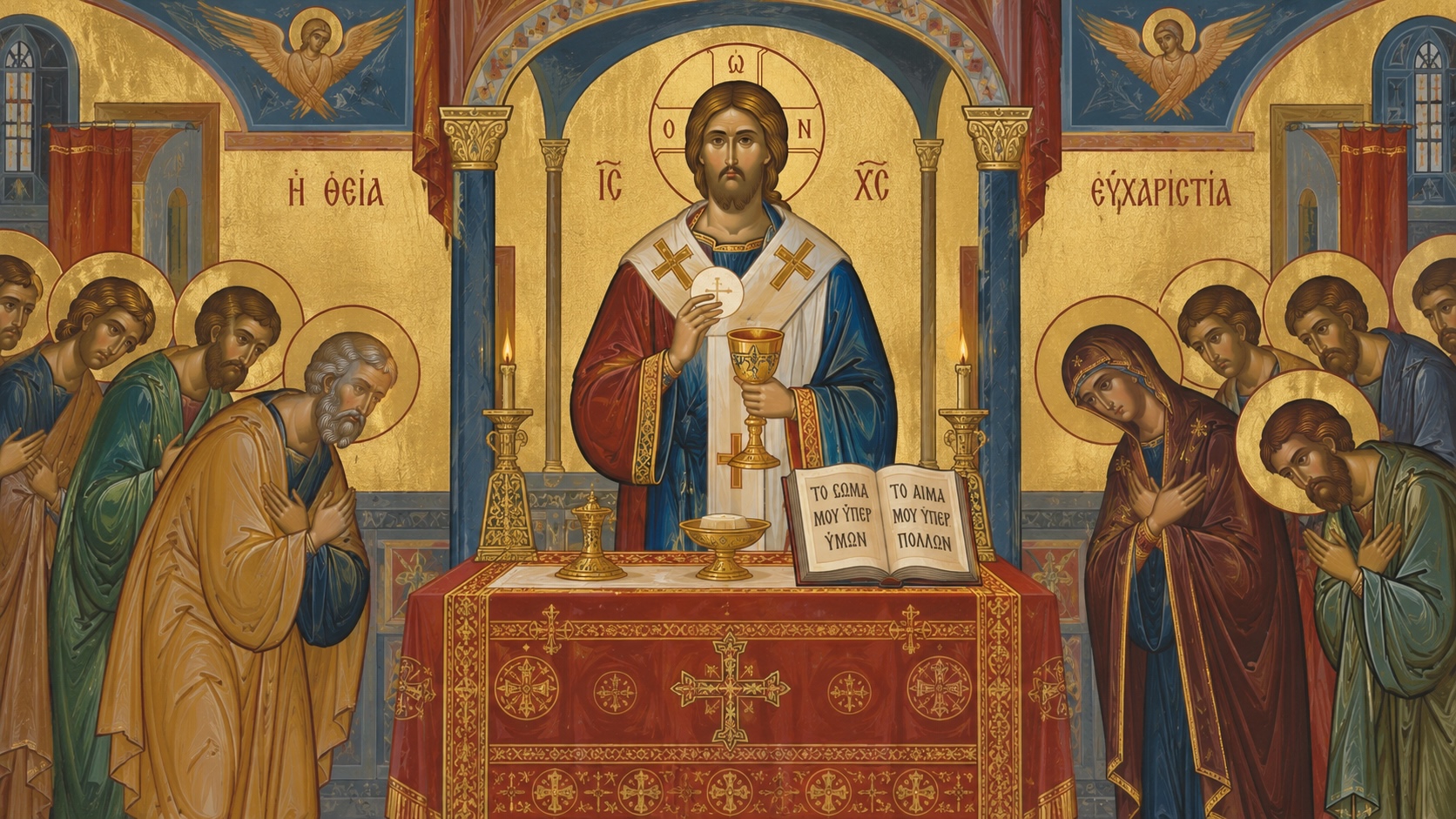
➕ Table of Contents
What exactly allows us to call a person, a community, or a Church Orthodox? At first glance, the answer seems obvious: an Orthodox Christian is someone who belongs to the Orthodox Church and professes the Orthodox faith. Yet the history of the Church itself shows that such a definition, while necessary, is insufficient.
One may know the Creed impeccably and at the same time live contrary to what it means. One may regularly participate in worship and treat the Eucharist almost as an obligatory religious ritual. Finally, one may speak at length about love and good works while taking an arbitrary approach to the Church’s doctrine and sacramental life.
The Christian tradition knows no such division. Faith, sacrament, and life are interconnected within it. Therefore, if we attempt to formulate the marks of Orthodox Christianity as concisely as possible, they can be reduced to at least three: orthodoxy — true faith, orthomysteria — true sacraments* and orthopraxy — authentic Christian life.
These three criteria do not compete with one another. On the contrary, each of them tests and confirms the other two.
* The first and third terms have long existed in theological language. Orthomysteria is used in this text as a working neologism formed according to the same model: from the Greek orthos — correct, true — and mysterion — sacrament, mystery. It does not denote a particular “correct sacrament,” but rather the correctness and authenticity of the sacramental life of the Church as such.
True Faith: Orthodox Christianity Begins with Orthodoxy
The very word Orthodoxy derives from the Greek orthodoxia — right opinion, right glorification, or right confession. There is therefore no reason to diminish the importance of dogma: from the very beginning, Christianity was not only a way of life but also an affirmation of a particular reality revealed to humanity from above.
Christ is not merely a moral teacher but the incarnate Son of God. God is Trinity. Christ truly rose from the dead. The human person is called to resurrection and life with God. The Eucharist is not merely a symbolic commemoration of the Last Supper. All these statements have a specific meaning, and changing that meaning changes Christianity itself.
Already in the New Testament there is a clear awareness that faith has a definite content which the Church receives, preserves, and transmits:
“Contend for the faith that was once for all entrusted to the saints” (Jude 1:3).
The formula “once for all entrusted” is particularly important here. The Christian faith is not reconstructed anew by each generation according to cultural fashions or the philosophical needs of the present day. It is precisely from this apostolic principle that the concept of Tradition later develops, concentrated in the professions of faith of the Ecumenical Councils and formulated in the dogmatic works of the Fathers of the Church.
But orthodoxy is not the mechanical repetition of correct formulas. Metropolitan Kallistos Ware, one of the best-known Orthodox theologians of the twentieth and twenty-first centuries, wrote:
“Faith is not the supposition that something might be true, but the assurance that someone is there”1.
For Ware, Christian faith is fundamentally personal: it is not merely assent to a particular set of propositions, but trust in God and an encounter with Him. At the same time, this encounter does not make dogmas unnecessary. On the contrary, dogmas establish precisely which God the Church is speaking about and what it affirms concerning His relationship with humanity.
Therefore, the phrase “the main thing is to be a good person; exactly what you believe is not so important” is, from an Orthodox perspective, incorrect. Christian ethics grows out of a particular vision of God and the human person. If Christ is simply an outstanding moral teacher, that is one religion. If He is the incarnate Logos and Son of God, it is an entirely different one.
Thus, the first mark of Orthodox Christianity remains the true confession of the faith of the Church. Yet dogmatic correctness alone does not make Christian life complete: it is the beginning, not the completion, of Christian life.
True Sacraments: Orthodox Christianity Has a Mystical Dimension
Christianity did not arise as a philosophical school or as a community of people united by identical views. From the very beginning, the Church was a community of baptism, prayer, the laying on of hands, and the Eucharist. This is why between orthodoxy and orthopraxy there is another dimension that can easily be lost if Christianity is viewed merely as a combination of doctrine and morality. This is the sacramental life of the Church. It is to designate this dimension that the term orthomysteria is proposed here.
This does not simply mean that a particular community performs rites called baptism, chrismation, or Eucharist. Orthomysteria presupposes the authenticity of the Church’s sacramental life: the sacraments are celebrated by the Church, in the fullness of her faith, within apostolic succession, providing mystical participation of the human person in the life of Christ.
This can already be clearly seen in the second century. Saint Ignatius of Antioch, arguing against those who denied the reality of Christ’s Incarnation, wrote:
“They abstain from the Eucharist and from prayer, because they do not confess the Eucharist to be the flesh of our Savior Jesus Christ”2.
For Ignatius, the question of the Eucharist was directly connected with the question of Christ. If God truly became man, if Christ had a real body, truly died and rose again, then the material world can become a bearer of grace. The water of baptism, the chrism of chrismation, and the bread and wine of the Eucharist cease to be merely pedagogical symbols. This is precisely why sacramental life is not an addition to the Orthodox faith: it is its mystical actualization.
For Orthodox theology, the Eucharist is neither a theatrical reconstruction of the Last Supper nor a psychological means of remembering Christ. It belongs to the very nature of the Church. Therefore, modern Orthodox Eucharistic ecclesiology, particularly in the works of Metropolitan John Zizioulas, emphasizes that the Church manifests herself most fully precisely as a Eucharistic assembly. Zizioulas even formulated this interdependence in a concise thesis:
“The Church constitutes the Eucharist while being constituted by it”3.
The same idea was developed with particular consistency by Protopresbyter Alexander Schmemann, for whom the Eucharist was not one among many ecclesiastical rites existing alongside others. It manifests the Church herself and the mode of being to which the Christian community is called:
“The Eucharist is not ‘one of the sacraments’ or one of the services, but the very manifestation and fulfillment of the Church in all her power, sanctity and fullness”4.
In another text, Schmemann develops the same principle from the perspective of human life:
“For Eucharist — ‘thanksgiving’ — is indeed the very content of the redeemed life, the very reality of the Kingdom as ‘joy and peace in the Holy Spirit’”5.
The sacrament, therefore, is not merely celebrated within the Church but introduces the human person into another mode of existence. It is in this sense that orthomysteria cannot be reduced to the formal correctness of the rite — although such correctness is itself extremely important.
This gives rise to an important criterion that is often missing from contemporary discussions about Orthodoxy. It is not enough to ask whether a particular community calls itself Orthodox or uses Orthodox terminology. One must also ask whether authentic ecclesial and sacramental life exists within it, whether there is continuity of apostolic ministry, and whether the Eucharist of the Church is truly present.
At the same time, another extreme is possible here: treating the mere fact of participation in the sacraments as a kind of automatic guarantee of Orthodoxy. Baptism may be received, yet a person may practically fail to actualize it. One may receive the Eucharist regularly while remaining indifferent to its mystical dimension. Moreover, even a profound experience of the sacrament loses its authenticity if a person fails to manifest love in relation to others. Kallistos Ware himself observed that a sacrament may be received, yet without faith its fruits will not become manifest in a person’s life6.
Here the thought of the Catholic theologian Hans Urs von Balthasar concerning the ontological consequences of Holy Communion is also relevant:
“And you can only receive him so that he can change you into himself”7.
The sacrament, therefore, is directed not only toward the mystical experience of an encounter with Christ but also toward the transformation of the human person. At this point, orthomysteria inevitably passes into orthopraxy.
Thus, the second criterion of Orthodox Christianity is the authentic sacramental life of the Church, but it too inevitably leads to the third.
True Deeds: Orthopraxy as a Test of Faith
The term orthopraxy is used far less frequently than orthodoxy in Orthodox circles, yet the idea itself runs throughout the New Testament. The Apostle James formulates it in terms that leave almost no room for ambiguity:
“So faith by itself, if it has no works, is dead” (James 2:17).
This is not an opposition between faith and works. On the contrary, for the Apostle, a deed is the visible manifestation that faith truly exists. A little later, he even observes that Abraham’s faith “was active along with his works” and through them reached its fullness.
From this follows an uncomfortable but thoroughly evangelical conclusion: dogmatically correct faith in itself does not yet testify to a person’s spiritual righteousness. The Apostle James deliberately sharpens the argument:
“You believe that God is one; you do well. Even the demons believe — and shudder” (James 2:19).
Thus, orthodoxy without orthopraxy is possible as an intellectual state. One can answer theological questions correctly while remaining far removed from the Christian way of life.
Father Alexander Men, commenting on the Epistle of the Apostle James, effectively formulates this problem in the language of orthopraxy:
“Theoretical certainty concerning the truths of Revelation is not genuine faith. Faith without ‘works’ is dead, and ‘works’ are service to one’s neighbors”8.
This is an important clarification: correctness of belief is not in itself identical with the fullness of Christian faith. One may speak correctly about God while simultaneously denying through one’s actions the practical consequences of what one professes.
The Romanian Orthodox theologian Dumitru Stăniloae wrote of this connection:
“The love we manifest in using these things as gifts must be directed not only toward God but also toward our neighbors so that we might gain love for them, and communion with them”9.
For Stăniloae, love is not a sentimental superstructure added to dogma. It is directly connected with God’s very mode of being as Trinity and must therefore become the mode of human existence as well. In his theology, communion with God cannot be completely separated from communion with another human being.
In other words, if orthomysteria is the experience of love for God, then orthopraxy is the manifestation of love for one’s neighbor.
This logic can be traced even further in Hans Urs von Balthasar, who formulates the principle:
“The inner reality of love can be recognized only by love”10.
This means that in Christianity love cannot remain merely the subject of a correct theological proposition. If God is known as love, the human response must likewise take the form of love. In Balthasar, the Word of God is not merely theo-logical but also theo-pragmatic: God does not merely communicate to the human person the truth about Himself but acts on that person’s behalf. Therefore, the response to Revelation cannot remain purely intellectual either.
For this reason, Orthodox orthopraxy is not the mechanical observance of a set of everyday rules. It is far broader than questions of fasting, forms of dress, or discipline of behavior in church. The Gospel identifies its criteria as love, mercy, truthfulness, forgiveness, rejection of hypocrisy, assistance to the weak, defense of the wronged, and the ability to see one’s neighbor in another human being. In the twenty-fifth chapter of the Gospel according to Matthew, Christ even describes the Last Judgment primarily in terms of a person’s treatment of the hungry, the thirsty, the stranger, the sick, and the prisoner.
It is therefore impossible seriously to affirm someone’s Orthodoxy solely on the basis of dogmatic or sacramental correctness if that correctness does not produce at least an aspiration toward an evangelical way of life.
This is perhaps one of the least popular criteria, because it is much easier to apply to others than to ourselves.
What Happens When One Element Is Missing
The proposed triad makes sense precisely because none of the three criteria functions fully on its own.
Orthodoxy without orthomysteria easily turns into religious ideology. A person may know the dogmas impeccably, argue about canons, and denounce heresies, while the Church in practice remains for that person merely a community of people holding correct views.
Orthomysteria without orthodoxy loses its own meaning, because it is impossible to separate the sacrament from the faith of the Church that celebrates it. The Eucharist has meaning precisely because the Church understands Christ, the Incarnation, the Church herself, and salvation in a particular way.
Orthomysteria without orthopraxy risks degenerating into ritualism or even a kind of magical attitude toward the sacraments: a person is baptized, receives Communion, observes the Church calendar, and yet sees no contradiction between his or her religious life and behavior directly opposed to the Gospel. Mystical experiences in such a context become a form of spiritual delusion — prelest — because they are not supported by love for one’s neighbor and thus undermine the reality and efficacy of the mystical experience itself.
Orthopraxy without orthodoxy and orthomysteria, in turn, may constitute a beautiful ethical system, humanism, or even heroic service to others. Yet by itself it does not make a person a disciple of Jesus Christ and a bearer of the Holy Spirit.
Finally, the combination of orthodoxy and orthomysteria without orthopraxy is particularly revealing. Formally, almost everything appears to be present: correct confession of faith, ecclesial belonging, baptism, Eucharist, liturgical life. Yet it is precisely this kind of religiosity that the Gospel’s constant criticism of hypocrisy addresses: outward correctness does not justify a life that contradicts what a person professes and celebrates.
Three Criteria Instead of One
In ecclesiastical discussions, Orthodoxy is too often defined by a single criterion. Someone is Orthodox because he or she belongs to the correct jurisdiction. Orthodox because he or she correctly professes the dogmas. Orthodox because he or she receives Communion in a canonical Church. Or, conversely, Orthodox because he or she is a good person and lives “like a Christian.” Each of these statements contains part of the truth, but none is sufficient on its own.
Orthodox Christianity presupposes orthodoxy, because Christianity makes specific claims about God, Christ, the human person, and salvation. It presupposes orthomysteria, because Christianity is not merely a worldview but life in the Church and participation in her sacraments. And it presupposes orthopraxy, because faith that finds no expression in a person’s relationship with God, one’s neighbor, and the world remains dead, in the words of the Apostle James.
Orthodoxy can therefore be described as the unity of true faith, authentic sacramental life, and authentic everyday life according to the Gospel. Or, more briefly: orthodoxy is what we believe; orthomysteria is what we live by in the Church; orthopraxy is how we live outside the walls of the church.
At the same time, this triad is far more useful not as an instrument for determining who around us is “Orthodox enough,” but as a means of examining our own Christianity. Do we truly preserve the faith we have received? Do we truly experience deeply the sacraments in which we participate? And can the Gospel we profess be recognized in our actions?
If one of these answers consistently remains negative, the problem is no longer one of terminology. The problem is the absence of Orthodoxy.
Literature
- Kallistos Ware, The Orthodox Way, revised ed., St Vladimir’s Seminary Press, 1995, p. 16.
- Ignatius of Antioch, The Epistle to the Smyrnaeans, 7.1.
- John D. Zizioulas, “The Ecclesiological Presuppositions of the Holy Eucharist,” Nicolaus 10, no. 1 (1982): 333–349.
- Alexander Schmemann, “Theology and Eucharist,” St Vladimir’s Seminary Quarterly 5, no. 4 (1961): 10–23.
- Alexander Schmemann, The Eucharist: Sacrament of the Kingdom, trans. Paul Kachur (Crestwood, NY: St Vladimir’s Seminary Press, 1987).
- Kallistos Ware, “A Conversation with Metropolitan Kallistos Ware on the Sacramental Life,” The Illumined Heart, Ancient Faith Radio, March 7, 2008.
- Hans Urs von Balthasar, Love Alone Is Credible, trans. D. C. Schindler (San Francisco: Ignatius Press, 2004), pp. 75–76.
- Alexander Men, Bibliological Dictionary, entry “Epistle of the Apostle James.”
- Dumitru Stăniloae, The Experience of God: Orthodox Dogmatic Theology, vol. 2, The World: Creation and Deification, trans. Ioan Ionita and Robert Barringer (Brookline, MA: Holy Cross Orthodox Press, 2000), pp. 18–19.
- Hans Urs von Balthasar, “Eucharist: Gift of Love.”