
 DE
DE  RU
RU  UK
UK 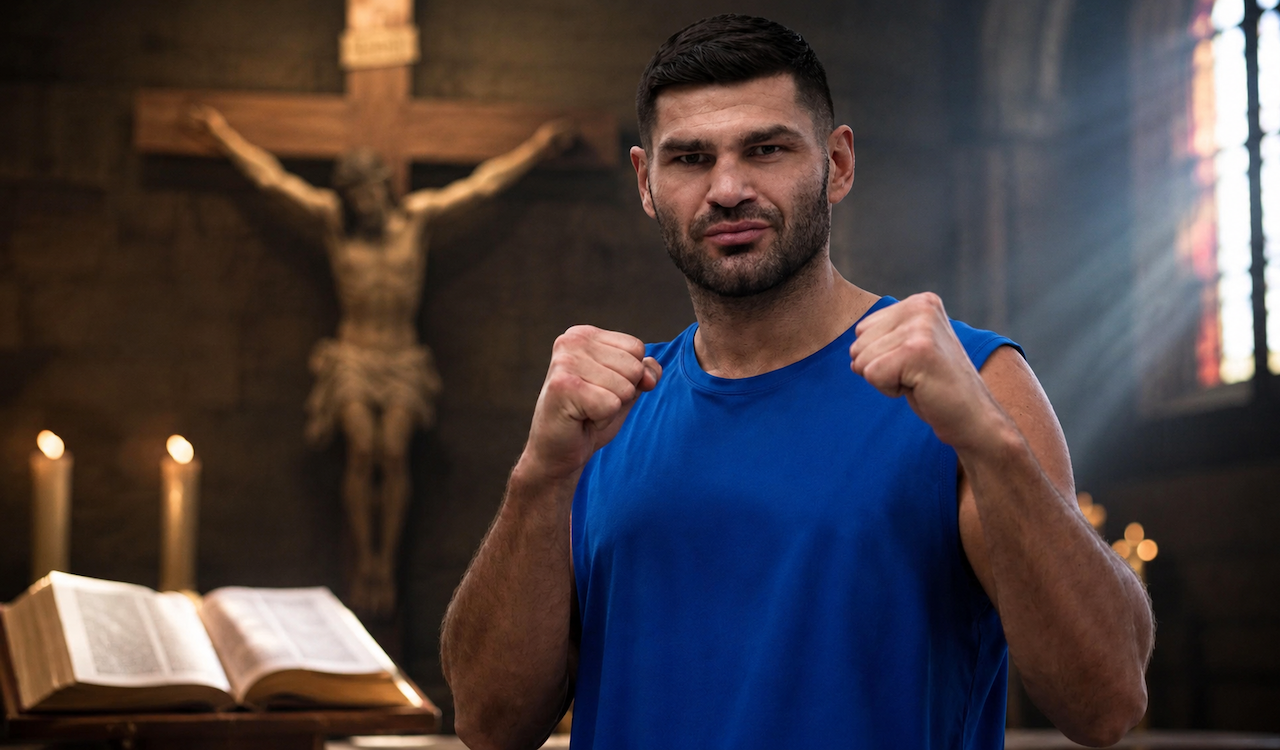
➕ Table of Contents
On August 29, 2026, Croatian boxer Filip Hrgović made one of the most important comebacks of his career: trailing Moses Itauma, he turned the fight around and became the IBF heavyweight world champion. But after the fight, it was not only his boxing abilities that attracted attention. Hrgović explained his victory in the language of Christian faith — and did so with remarkable directness.
“It was Jesus Christ in me,” he said after the fight, describing the strength he felt at the decisive moments of the bout. Hrgović also spoke about the Holy Spirit, the Father, and his gratitude to Jesus Christ. For a professional athlete who had just won a world championship title, this was not an ordinary symbolic “thank God,” but an open religious testimony.
However, Hrgović’s words after the victory did not come out of nowhere. As early as 2015, he publicly stated: “I believe in God, I am Catholic.” Eleven years later, his accounts of faith have become much more detailed. The boxer says that he prays and reads the Bible every day, attends Holy Mass every Sunday, and has been taking the Bible with him to every training camp for about ten years. He also speaks of God as the most important reality in his life, placing his relationship with Him above money, fame, and sporting achievements.
Therefore, Filip Hrgović’s religious views are of particular interest. We are not simply dealing with an athlete who occasionally mentions God, but with a man who himself describes a significant part of his sporting and personal history through the categories of Christian faith.
“I Believe in God, I Am Catholic”: Hrgović’s Direct Testimony About His Faith
The earliest clear public testimony about Filip Hrgović’s religious views dates back to 2015. In an interview with the Croatian Večernji list, the journalist directly asked the young boxer whether he was a believer, like other members of his family.
Hrgović’s answer was unequivocal: “I believe in God, I am Catholic.” He did not leave his answer at the level of a general belief in God, but immediately identified his denominational affiliation as well — Catholicism. This is important because it allows us to speak about his Catholic identity not on the basis of external symbols or assumptions, but on the basis of his own public testimony.
In the same interview, Hrgović said that he attends Sunday Mass. Thus, his statement about Catholicism in 2015 was accompanied by a reference to a specific religious practice. Faith was not merely a matter of family or cultural affiliation for him: he connected it with his personal life and spoke about the strength he received from God.
It is particularly significant that this testimony came long before his current worldwide popularity. At that time, Hrgović was not yet a world champion and did not occupy the position that now gives his words international attention. His early statement about his Catholic faith is therefore an important starting point for understanding his later statements.
Even then, faith was connected for Hrgović with strength and inner support. This same characteristic would later become apparent in his 2026 interviews, when he spoke about the Bible, prayer, Jesus Christ, and the Holy Spirit. However, there is an important difference between these testimonies: in 2015, Hrgović primarily identified himself as a Catholic, whereas in 2026 he described his personal experience of faith in considerably greater detail.
Therefore, if one is looking for the most reliable starting point for examining Hrgović’s religious views, it is his own concise formula: “I believe in God, I am Catholic.” Everything that followed in his public testimony can be viewed as a development and elaboration of this declared Christian identity.
Faith as a Family Tradition
In the same 2015 interview, Hrgović connected his faith not only with a personal choice but also with the family environment in which he grew up. In answering questions about his religiosity, he mentioned his parents and explained that belief in God was part of his family.
This is an important detail for understanding his worldview. In his early testimony, Catholic faith appears not as a recently acquired conviction, but as part of the family heritage and upbringing through which he first encountered the Christian tradition.
Hrgović also mentioned his future wife, Marinela, describing her as a believer. Thus, religion was present not only in his parental family but also in his closest personal environment.
At the same time, it would be wrong to reduce his faith simply to tradition. The fact that a person grew up in a Catholic family does not by itself mean that they personally remain religious. In Hrgović’s case, what matters is that he himself confirmed this faith, spoke about attending Mass, and connected it with his inner strength.
His biography can therefore be understood on two interconnected levels. The first is familial and cultural: the Catholic tradition in which he was raised. The second is personal: his own decision to remain a believer and practice his faith.
This distinction becomes particularly clear in Hrgović’s later testimony. If in 2015 he was primarily speaking about where his faith came from, eleven years later he was already describing in detail how he himself practices it — through the Bible, prayer, Mass, and personal reference to Jesus Christ.
The Bible as a Personal Spiritual Authority
In 2026, Hrgović was already speaking about faith not only as denominational affiliation or family tradition. One of the clearest testimonies of this was his account of the Bible, which he takes with him to training camps.
Ahead of his fight with Moses Itauma, the Croatian boxer showed the things he takes with him to training camp. The first and most important item he mentioned was the Bible. Hrgović explained that he has been taking it with him for about ten years, meaning that this practice began long before his current status as a world champion.
It is particularly revealing that the athlete refers to the Bible as the Word of God. For him, it is not simply a book he reads from time to time, but a means of remaining connected with God during difficult preparation, trials, and the sacrifices associated with sport.
Thus, Scripture occupies a special place in his religious life. If Catholic identity can be understood as belonging to a particular Christian tradition, regular recourse to the Bible already points to a personal practice of faith.
It is also important that Hrgović associates reading the Bible specifically with the training camp. Professional boxing requires prolonged isolation, physical exertion, and psychological endurance. In this environment, according to his own testimony, the Bible serves as a source of spiritual support.
It is noteworthy that this practice has continued for approximately ten years. Therefore, it cannot be explained solely by the emotional excitement surrounding the 2026 championship fight. The Bible accompanied Hrgović throughout a significant part of his professional career — including periods when he had not yet become a world champion.
For this reason, his attitude toward Scripture is an important link between his early statement “I am Catholic” and his present open testimony about Christ. It shows that behind his denominational identity stands a concrete practice: Hrgović consciously sustains his faith through continual recourse to the Bible.
“My Relationship with God Is the Most Important Thing in Life”: Faith Above Money and Fame
In a more recent interview, Hrgović speaks about faith as the foundation of his own system of values. Answering questions about the life of a professional athlete, he emphasized that a person’s relationship with God is the most important thing, while money and fame in themselves remain empty.
This idea is particularly significant in the context of his career. Hrgović spent many years striving to become a world champion, and in 2026 he finally achieved that goal. Yet even before the championship fight, he emphasized that sporting popularity should not become a person’s highest value.
In explaining his position, the boxer referred to the Gospel idea about the soul: what good is it for a person to gain the whole world if they lose their soul? His attitude toward money and fame is therefore directly connected with the biblical understanding of the human person.
For Hrgović, this does not mean giving up professional ambitions. He wants to win, strives for titles, and takes his career seriously. Rather, it is a matter of a hierarchy of values: a world championship title has significance for an athlete, but it cannot determine the ultimate value of his life.
This understanding also explains his reservations about the early fame of young boxers. In his view, popularity and large amounts of money can become a problem if a person begins to identify them with their own worth. In this sense, faith serves for him as a kind of criterion by which he evaluates success.
Hrgović also connects this position with the inevitability of death. Earthly fame has a limited duration, whereas he regards the question of a person’s relationship with God as far more important. This is why his words about God cannot be reduced to asking for help in winning another fight.
In his worldview, a sporting victory is valuable, but not ultimate. One can become a world champion, gain money and international recognition — but, in Hrgović’s conviction, none of this replaces what matters most: one’s relationship with God.
This is already a much broader understanding of Christian faith than a simple denominational self-identification. If in 2015 Hrgović said, “I believe in God, I am Catholic,” then in his later statements he shows what practical consequences this faith has for his understanding of success, fame, and the meaning of life itself.
Jesus Christ as Personal Lord
The distinctly Christian character of Hrgović’s faith was most clearly expressed after his victory over Moses Itauma. If his earlier statements allowed us to speak about Catholic identity, the Bible, and belief in God, then after the championship fight he speaks directly about Jesus Christ.
In his post-fight speech, Hrgović said: “It was Jesus Christ in me,” explaining in this way the strength that, according to his own experience, he received during the most difficult part of the bout. This formulation is much more personal than an ordinary expression of gratitude to God.
For Hrgović, Jesus does not appear simply as a historical figure or the central character of the Christian religion. His words express the conviction that Christ can truly act in a person’s life and be a source of inner strength.
This is consistent with his earlier testimony. Speaking about a difficult period after moving to Great Britain, the boxer said that at that time he felt lonely and lost, but that he had Jesus, the Bible, and prayer. Thus, his appeal to Christ existed long before the moment of his championship victory.
After the fight, his language became even more explicit. Hrgović spoke about the Father, the Son, and the Holy Spirit, and concluded his post-fight thanks by addressing Jesus Christ. His public testimony therefore has not merely a generally religious but distinctly Christian and Trinitarian character.
At the same time, these statements should be kept within the limits of what the athlete actually said. Hrgović does not offer a systematic theological explanation of what exactly he means by “Jesus Christ in me.” It would therefore be inappropriate to attribute to him a particular theological concept that he himself has not formulated.
But one thing is clear: Jesus Christ occupies a central place in his contemporary language about faith. For Hrgović, Christ is the One to whom he gives thanks, to whom he turns in difficult moments, and whose presence he associates with his own inner strength.
This is precisely where his public statements of 2026 most clearly move from the declaration “I am Catholic” toward personal Christian testimony.
“It Was Not Me”: The Theological Meaning of Hrgović’s Statement
Hrgović’s phrase “It was not me” deserves separate consideration because it shows how the athlete understands the moment of greatest physical strain. This is not simply an expression of gratitude after a victory: Hrgović effectively shifts the emphasis from his own abilities to the action of God.
In his account of the fight, he said that up to a certain point in the bout it was extremely difficult for him, but then he felt a strength that, in his experience, could not be explained solely by his physical abilities. He associated this strength with the Holy Spirit. In another formulation, he said that what happened in the ring was not himself, but Jesus Christ in him.
Here it is important to distinguish the sporting fact from his religious interpretation of it. The fight itself was the result of physical preparation, tactics, endurance, and the work of his team. But Hrgović himself gives the result another, spiritual dimension: he believes that at a critical moment he received from God the strength he needed.
Interestingly, he applies a similar way of thinking to other events in his career. After the victory, Hrgović said that God brought him together with trainer Abel Sanchez and manager Keith Connolly. In other words, he sees God’s action not only in the extraordinary moment of the fight, but also in the chain of concrete circumstances that preceded it.
This approach can be understood as an element of a providential interpretation of his own biography. Hrgović does not claim that he did nothing himself. On the contrary, his career consists of years of training, defeats, comebacks, work with various specialists, and constant preparation. However, looking back, he interprets these events as having taken place under God’s guidance.
This is particularly important because this perspective encompasses not only successes. In previous years, Hrgović experienced serious professional difficulties, including his defeat by Daniel Dubois, after which he even considered ending his career. Now he views that period from a different perspective — as part of the path that ultimately led him to the world championship.
Therefore, the phrase “it was not me” should not be understood literally as a denial of his own role in the victory. Its meaning lies elsewhere: Hrgović does not regard himself as the ultimate source of the strength that enabled him to get through the most difficult moment of the fight.
This is where the most interesting theological aspect of his testimony lies. An athlete who has achieved the highest professional goal does not say, “I proved that I was stronger than everyone else.” Instead, he speaks about Christ and the Holy Spirit. His championship therefore becomes for him not merely evidence of his own ability, but an occasion to give glory to God.
From Catholic Identity to Personal Christian Spirituality
A comparison of Hrgović’s statements from different years reveals an interesting development. At the same time, it is important not to describe it as a change of faith without sufficient evidence. The available testimony rather shows how the public formulation of his religious convictions has become considerably more specific.
In 2015, Hrgović’s answer was brief: “I believe in God, I am Catholic.” He also spoke about Sunday Mass and connected his faith with family tradition.
Eleven years later, his religious language has become much more personal. He speaks about the Bible, which he has taken with him to training camps for a decade, about prayer, about his relationship with God, and about the fact that he considers this relationship the most important thing in life.
His language about Christ is even more explicit. After his championship fight, he no longer simply says that he believes in God, but directly speaks of Jesus Christ, the Holy Spirit, and the Father. He attributes the strength he felt at a decisive moment of the fight to the Holy Spirit and thanks Jesus Christ for the victory.
Thus, between 2015 and 2026, we can see not so much a change in denominational position as a transition from a brief declaration of identity to an extended personal testimony of Christian faith.
This distinction is fundamental. There is no basis for claiming that Hrgović changed his denomination or beliefs during this period. On the contrary, his early statement about being Catholic and his later words about God, the Bible, Jesus Christ, and the Holy Spirit generally remain within a Christian worldview.
What has changed above all is the degree of openness and detail. In the early interview, religion is one of the characteristics of a young athlete. In later interviews, it becomes a language through which Hrgović explains his own experience, difficulties, psychological state, professional path, and even the most important moment of his career.
Therefore, today’s Hrgović can be described not simply as an athlete who “is Catholic,” but as a person who publicly gives personal Christian testimony. At the same time, his own words, rather than assumptions made by outside observers, remain the principal source for such a conclusion.
Is Hrgović a Practicing Catholic?
The question of Filip Hrgović’s denominational affiliation has a fairly clear answer, but the question of his current Catholic practice requires greater caution.
In 2015, Hrgović explicitly called himself Catholic and said that he attends Sunday Mass. This is sufficient grounds for speaking about his Catholic identity at that time. At the same time, more than ten years have passed, and not every detail of his religious life then can automatically be transferred to 2026.
As for the contemporary period, we have much more recent testimony. Hrgović speaks about regular prayer, reading the Bible, and attending Mass. In particular, in an interview shortly before the championship fight, he said that he goes to Holy Mass every Sunday, even while at training camp.
This is important because it shows that his Catholic identity has not remained merely a memory of childhood or youth. According to his own recent testimony, participation in Catholic worship remains part of his life.
At the same time, one should not draw conclusions that Hrgović himself has not drawn. For example, his public interviews do not provide grounds for assessing in detail his attitude toward every aspect of Catholic doctrine, the frequency of confession, or other aspects of sacramental life. Nor is there any basis for attributing particular theological views to him solely on the basis of general statements about God.
The most accurate way to formulate the situation is this: Hrgović has publicly identified himself as Catholic, while his contemporary testimony contains indications of practicing Catholic life — in particular, participation in Holy Mass. At the same time, he speaks about the Bible, prayer, Jesus Christ, and the Holy Spirit in language that clearly belongs to Christian faith.
This allows us to avoid two extremes. On the one hand, there is no reason to reduce his religiosity to the formal label “Catholic.” On the other, we should not attribute theological positions to Hrgović that he has not publicly expressed.
The most careful and, at the same time, well-supported conclusion is therefore the following: according to the available public testimony, Filip Hrgović is a Christian who identifies as Catholic and speaks about a practical life of faith — prayer, the Bible, and Holy Mass. His most recent statements additionally demonstrate personal faith in Jesus Christ and the Holy Spirit.
George Foreman as a Christian Example
In a 2025 interview with Večernji list, Hrgović also spoke about the boxers he particularly admires. Among them he named George Foreman, one of the most famous figures in heavyweight boxing history.
For Hrgović, Foreman is interesting not only as an outstanding athlete. What particularly attracts the Croatian boxer’s attention is Foreman’s religious journey and his open Christian testimony. After ending the first stage of his professional career, Foreman became a Christian preacher and later returned to boxing, becoming world champion again at the age of 45.
The combination of sport, personal transformation, and faith makes Foreman’s story particularly meaningful in the context of Hrgović’s worldview. He sees in him not merely a former champion, but an example of a person for whom sporting status did not become the ultimate meaning of life.
This echoes Hrgović’s own statements about money and fame. For him, a career matters, but it should not displace a person’s relationship with God. Foreman is a compelling example in this respect: a person can reach the pinnacle of sporting fame, lose it, change his life, and later return to the highest level.
It is also revealing that Hrgović speaks about Foreman in the context of the wholeness of a person. What impresses him is not only the American’s punching power or sporting achievements, but also the person he became outside the ring.
The reference to Foreman therefore helps us better understand Hrgović himself. It shows that his interest in Christianity does not exist separately from his idea of what an athlete and a person should be. For him, a great boxer is not necessarily the one who merely wins titles. What matters much more is what happens to that person outside their sporting career.
In this sense, George Foreman serves as a kind of example of a Christian athlete, in whom sporting greatness and faith do not exclude one another. And this model — an athlete for whom God remains more important than fame — corresponds closely with the way Hrgović himself describes his values.
Christian Faith and Sports Psychology
For Hrgović, faith has not only a worldview dimension but also a practical one. He connects it with the inner resilience required of a professional boxer, especially in moments of uncertainty, pressure, and physical exhaustion.
It is significant that in August 2026, while preparing for his fight for the world title, Hrgović spoke not only about the intensity of his training. He also emphasized that he goes to Mass every Sunday, even while at training camp far from home, because it “means a lot to him.”
His faith therefore does not exist separately from his professional preparation. On the contrary, religious practice becomes part of the routine that helps him get through difficult periods in his career. The Bible, which he has taken to training camps for about ten years, has a similar significance in this context: it accompanies him precisely where sport requires the greatest discipline and psychological endurance.
The experience of his defeat by Daniel Dubois is particularly important. It was Hrgović’s first professional defeat, and the fight ended because of injury rather than a knockout. Hrgović later continued his career, won several fights, and eventually received the opportunity to fight for a world title.
His contemporary attitude toward sport is therefore difficult to reduce to the simple formula “faith helps him win.” In his statements, faith rather serves as a source of inner support regardless of the outcome. This fits well with his conviction that a relationship with God is more important than money, fame, and sporting achievements.
This attitude was most clearly expressed after the fight with Itauma. Hrgović did not explain his comeback solely through physical preparation, although it was precisely months of preparation that enabled him to endure the fight. Instead, he described the decisive moment through the action of the Holy Spirit: according to his account, the energy he felt “was not my energy.”
Thus, for Hrgović, Christian faith serves at least two functions. On the one hand, it is a source of spiritual identity and meaning. On the other, it helps him interpret the trials of professional sport: defeats, difficult training, uncertainty, and moments when an athlete is required to continue despite exhaustion.
At the same time, Hrgović does not set faith against professional discipline. He continues to train, work with his team, and prepare for fights. Christianity, in his own account, does not eliminate the need for effort, but gives a different interpretation of where a person receives strength and to whom ultimate thanks for the result belongs.
The Ukrainian Context: Usyk, the Vacant IBF Title, and Hrgović’s Championship
Filip Hrgović’s championship title has a direct connection with Ukrainian boxing, because the IBF belt became vacant after Oleksandr Usyk relinquished the title in June 2026. Following Usyk’s decision, Hrgović’s fight with Moses Itauma became a bout for the vacant world championship.
Thus, Hrgović became champion in the belt previously held by one of the most successful Ukrainian boxers in history. Usyk vacated the IBF title as part of his decision to relinquish his world championship belts, opening the way for a new champion to be determined.
For Hrgović himself, this story has another important dimension. He had long been among the leading contenders for the title, but his path to the championship proved considerably more difficult than his status as one of the leading heavyweights might have suggested. In 2024, he suffered his first professional defeat to Daniel Dubois, and after that he even seriously considered his future in boxing. Only later did he return to the ring and gradually move back toward a title fight.
In this context, his championship can be viewed as the culmination of a long professional cycle: from defeat and doubts about continuing his career to victory over Itauma and the IBF title.
At the same time, one should not artificially connect this sporting story with Hrgović’s religious views. The significance of the Ukrainian context here is primarily sporting: Usyk’s decision to vacate the belt created the situation that ultimately led to Hrgović fighting for the title. Hrgović himself, when reflecting on this victory, then gave it his own religious meaning, speaking about God, Jesus Christ, and the Holy Spirit.
Thus, in the sporting history of the 2026 IBF belt, the Ukrainian and Croatian boxers became directly connected: Usyk vacated the title, and Hrgović became its new holder. For Hrgović, this was the culmination of his career, which he himself, in turn, interprets not only through sporting effort but also through the language of his Christian faith.
Conclusion: What Is Filip Hrgović’s Christianity Like?
Filip Hrgović’s public statements allow us to outline his religious worldview with considerable clarity, without resorting to speculation. He has identified himself as a Catholic and a believer, has spoken about attending Holy Mass, and in recent years has described his personal faith in God in considerably greater detail.
The Bible occupies an important place in his spiritual life. According to Hrgović’s own words, he has been taking it with him to every training camp for about ten years. This shows that Scripture is not merely a symbol of religious affiliation for him, but a constant element of his personal life.
His attitude toward God is equally important. Hrgović explicitly says that his relationship with God is more important to him than money and fame. Thus, Christian faith shapes not only his self-identification but also a particular hierarchy of values in which sporting success is not the highest good.
His contemporary Christian self-understanding was most clearly expressed after his victory over Moses Itauma. Speaking about the turning point in the fight, Hrgović attributed the strength he received to the Holy Spirit, said “it was Jesus Christ in me,” and concluded his victory by thanking Christ. His reference to the Father, the Son, and the Holy Spirit also has a clearly Trinitarian character.
At the same time, it is important to maintain a distinction between describing his faith and providing a theological interpretation. Hrgović is not a theologian and does not formulate a systematic teaching on Christian faith. His statements should therefore primarily be understood as the personal testimony of an athlete about God, Christ, the Bible, and his own spiritual experience.
There is likewise no basis for speaking of a change in his denomination. On the contrary, the available testimony allows us to trace a continuity from his early statement “I am Catholic” to a much more open and personal Christian testimony in 2026.
In this sense, the story of Filip Hrgović is interesting not only to boxing fans. His example shows an athlete who, having reached the highest professional goal, did not place the championship title at the top of his system of values. Instead, at the moment of his greatest sporting victory, he once again turned to what he had spoken about for many years — God, the Bible, Jesus Christ, and faith.