
 DE
DE  RU
RU  UK
UK 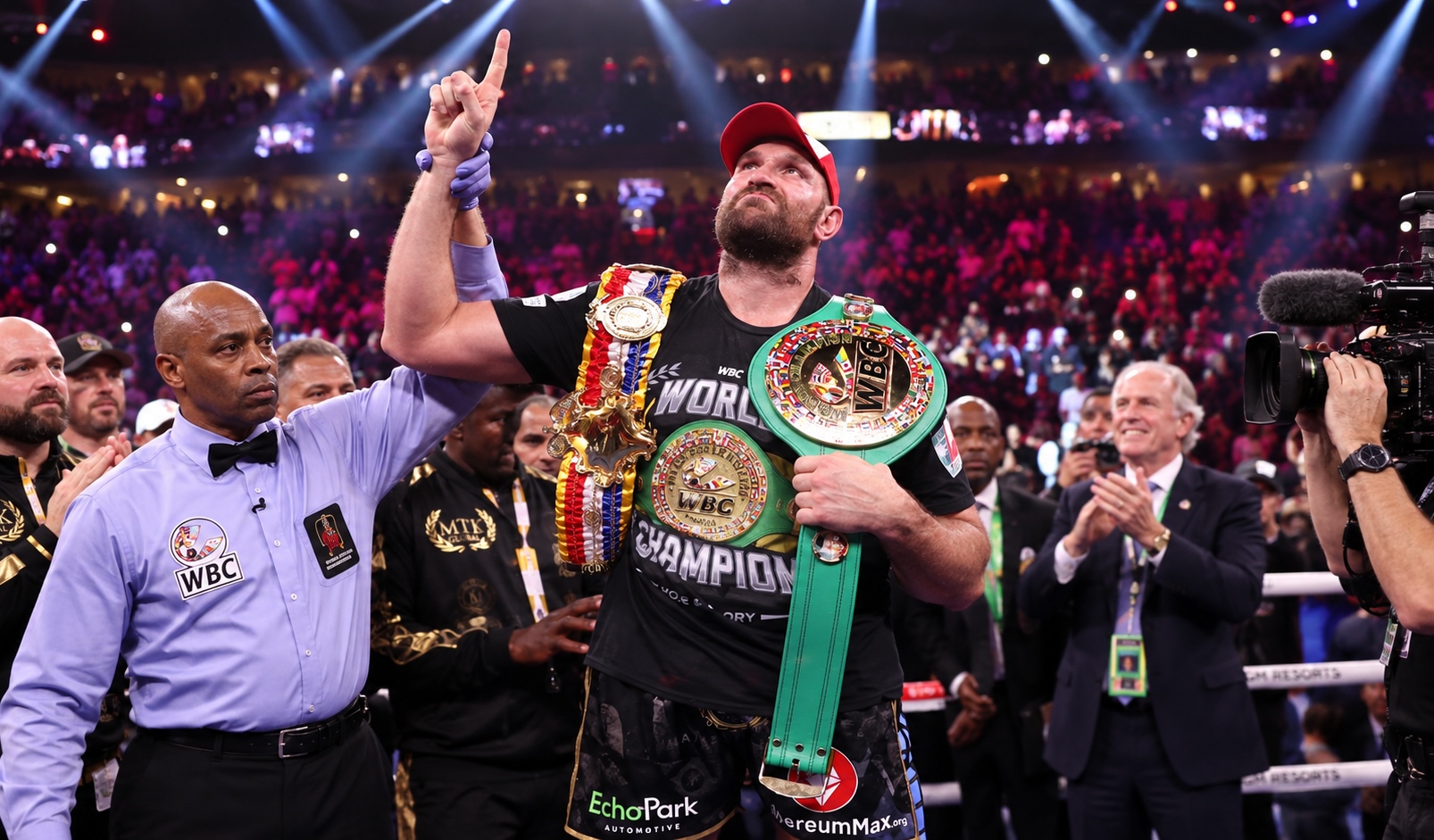
➕ Table of Contents
Tyson Fury is one of the most prominent and, at the same time, most controversial boxers of our time. His career consists not only of championship titles, major victories, and public conflicts. For many years, Fury has openly spoken about God, Jesus Christ, prayer, and the Bible, while directly linking his own return after a profound personal crisis to faith and God’s help.
At the same time, his religiosity is difficult to fit into a simple denominational formula. Fury grew up in an environment where Catholic tradition intersected with Protestant influence, while in adulthood he began using the language of personal conversion, salvation, and a close relationship with Christ characteristic of evangelical Christianity.
Therefore, in Tyson Fury’s case, it is interesting not only to determine which denomination he identifies with. It is far more important to examine what his faith looks like in practice: what place the Bible and prayer occupy in his life, how he speaks about Jesus Christ, how he explains his own victories and failures, and how he combines Christian convictions with professional boxing, fame, money, and a controversial public image.
“Getting to heaven is more important than becoming a champion”: an early testimony of faith
Tyson Fury began speaking publicly about his faith long before he became one of the biggest stars in world boxing. As early as 2011, when he was only beginning to win British and Commonwealth heavyweight titles, religion already occupied a prominent place in his interviews. And he spoke about it not as a cultural tradition or family heritage, but as a matter of personal salvation.
In one interview from that period, Fury said directly that “getting to heaven is the most important thing a man or woman can do,” and that being in a right relationship with God was more important to him than sporting achievements. In another formulation, he even contrasted faith with boxing: he was prepared to be knocked out ten times rather than lose his hope of salvation.
Such words are important for understanding Fury’s later religiosity. Christian rhetoric did not appear in his public image after he became a champion or after his famous return from a personal crisis. In the early 2010s, he was already speaking about God as the main point of orientation in his life, praying regularly, reading the Bible, and trying to attend church every Sunday. According to the boxer himself, Scripture gave him inner strength and confidence: if God was “in his corner,” then fear of an opponent lost its significance.
I would rather get knocked out ten times than lose my chance of getting to heaven.
Tyson Fury
It is also characteristic that Fury tried to understand even professional boxing through this system of values. Before his fight with Derek Chisora, he said that he prayed not only for his own victory but also that his opponent would remain unharmed after the bout. He regarded boxing as a sport and as a talent that a person receives and should use, but not as the highest purpose of life.
This is why Fury’s early statements allow us to distinguish his personal religiosity from the customary rhetoric of athletes thanking God after a victory. For the young Fury, the question was not whether God would help him win a particular fight. He spoke about a much broader perspective: salvation, sin, the Last Judgment, and the need to be reconciled with God.
At the same time, an important feature already appears here that would later make his denominational identity less straightforward than it might seem. Fury spoke about himself in a Catholic context, but the language of his faith — personal conversion, salvation, constant Bible reading, and an emphasis on a personal relationship with God — was shaped to a significant extent by evangelical Christianity. This issue deserves separate consideration.
Catholic or Protestant?
Tyson Fury’s denominational affiliation is not easy to describe in a single word. His biography includes both Catholic tradition and a clear influence of evangelical Christianity, so any attempt to describe him unreservedly as either simply Catholic or simply Protestant would be an oversimplification.
Fury grew up in a religious environment: his father came from a Catholic tradition, while his mother’s family was more strongly influenced by Protestantism. In his early interviews, Fury himself spoke about attending church, prayer, and faith in God, but from the beginning his religious language also displayed features more characteristic of evangelical Christianity: personal conversion, the need to be “saved,” constant Bible reading, and an emphasis on a direct personal relationship with Jesus Christ.
A particularly important role in shaping his faith was played by his uncle, who was a neo-Protestant Christian and preacher. It was largely through this influence that elements appeared in Fury’s religiosity which are difficult to explain solely by his Catholic upbringing. He often speaks about being “born again,” personally accepting Christ, and salvation through faith — in other words, he uses language typical of evangelical and Pentecostal circles.
At the same time, Fury does not demonstrate any desire to distance himself clearly from Catholicism or to build his own identity around denominational opposition. Judging by his public statements, what matters far more to him is not the question of ecclesiastical jurisdiction but personal faith in God, reading Scripture, prayer, and acknowledging Jesus Christ as his Lord and Savior.
It is therefore more accurate to speak not of “Fury the Catholic” or “Fury the Protestant,” but of a Christian with Catholic cultural roots and a strong evangelical influence. This religious mixture also helps explain the style of his public statements: he easily combines traditional Christian vocabulary with highly personal and emotional testimony about Christ.
This is why the next question is central: who is Jesus Christ for Fury himself — a symbol of faith, a moral teacher, or his personal Lord?
Jesus Christ as the center of personal faith
If, in his early interviews, Tyson Fury speaks frequently about God, salvation, and the need to get to heaven, over the years his public testimony becomes increasingly Christ-centered. He does not limit himself to general statements about belief in a higher power, but regularly and directly calls Jesus Christ his Lord and Savior.
After defeating Wladimir Klitschko in 2015, when Fury became heavyweight world champion for the first time, one of his first public statements was an expression of gratitude to Christ. The boxer said that he had won “through the power of Jesus” and called Him his Lord and Savior. This is an important detail: even at what was then the greatest moment of professional success in his career, Fury interpreted the victory not merely as the result of training or his own talent, but within a religious perspective.
Around the same period, while responding to criticism of his views, he stated his position even more directly:
I believe in the Lord Jesus Christ. I will say that regardless of how many people it offends.
Tyson Fury
For Fury, faith in Christ in this sense is not a private part of life that should remain outside sport or the public sphere, but a part of his self-identification.
This feature remained unchanged in later years. After defeating Deontay Wilder in 2020, Fury once again began his post-fight remarks by thanking “the Lord and Savior Jesus Christ.” Such words might have been perceived as a conventional religious formula common among many athletes if they had not been repeated over many years and combined with other elements of his spiritual life — constant Bible reading, prayer, and conversations about salvation.
As early as 2011, Fury entered the ring wearing a T-shirt bearing the words “I found Jesus.” According to the recollection of a journalist who spoke with him at the time, the boxer talked about his love for Christ and his desire to tell other people what Christ had done for their salvation. Thus, Fury’s public Christ-centeredness is not a late addition to his championship image either.
For him, Jesus Christ appears simultaneously as Savior, source of strength, and the central figure in his personal relationship with God. This feature in particular brings Fury’s religious language close to evangelical Christianity: the main emphasis is placed not so much on denominational self-definition as on personally accepting Christ, repentance, and salvation through Him.
In later interviews, this position remains unchanged. When asked about the state of his faith, Fury said that he had a good relationship with God, read the Bible every day, and was convinced:
Without God, nothing is possible. With God, everything is possible.
Tyson Fury
Therefore, when discussing Tyson Fury’s Christianity, it is difficult to regard Jesus Christ merely as part of an inherited religious tradition. In the boxer’s own statements, Christ appears as the center of his faith — the One through whom he speaks about salvation, victories, personal trials, and the meaning of life.
The Bible as a constant spiritual practice
One of the most consistent features of Tyson Fury’s religiosity is his attitude toward the Bible. In various interviews over many years, he has repeatedly said that he regularly reads Scripture and regards it not as a cultural symbol or part of family tradition, but as a practical spiritual guide.
For Fury, reading the Bible is connected primarily with maintaining a personal relationship with God. He speaks about it as an ordinary part of everyday life — alongside prayer, family, and training. In later interviews, the boxer stated directly that he reads the Bible every day and tries not to separate his faith from his professional career or everyday life.
This fits well with the general character of his Christianity. While traditional denominational self-identification places importance on church affiliation, liturgy, and participation in the sacraments, Fury places a much more visible emphasis elsewhere: constant personal engagement with Scripture, prayer, and a direct relationship with Christ. This is why his religiosity has clear features of evangelical Christianity.
At the same time, Fury does not use the Bible merely as a source of motivational quotations. In his statements, he regularly turns to themes that directly arise from the biblical worldview: sin, repentance, salvation, the soul, the Last Judgment, the temporary nature of earthly glory, and the need to be reconciled with God. These concepts appear so frequently in his public language that without the biblical context, much of his religious rhetoric would simply lose its meaning.
This is especially evident in Fury’s attitude toward success. He has repeatedly said that money, popularity, and championship belts have no ultimate significance if a person loses their relationship with God. This essentially repeats the Gospel logic that gaining the whole world cannot compensate for losing one’s own soul.
Therefore, the Bible in Fury’s life is not simply another marker of his Christian identity. It shapes the very language through which he explains the world, his own victories, failures, fears, and priorities in life. And from this daily practice logically follows another important element of his spiritual life — prayer.
Prayer as part of everyday life
Prayer occupies no less important a place in Tyson Fury’s religious life than reading the Bible. In his interviews, he has repeatedly emphasized that he prays not only before a fight or in moments of danger, but throughout the day — before meals, before going to sleep, while walking, and at other ordinary moments of everyday life.
For him, prayer is not a kind of sporting ritual intended to secure victory. Fury speaks about it primarily as a way of maintaining a constant connection with God. This is why his prayers concern not only his own needs or success in the ring. He has said that he also prays for his family, for the people around him, and even for the opponents he is going to fight.
His attitude toward prayer before fights is particularly revealing. Fury has repeatedly emphasized that he asks God not simply to help him win, but to preserve the health of both boxers. This is an important detail, because it shows that even in the context of a harsh professional sport, he tries to think in terms of Christian responsibility toward another person.
Prayer also played a key role in the way Fury himself explains one of the most difficult periods of his life. After defeating Wladimir Klitschko and winning the championship belts, his career effectively came to a halt, while his personal life entered a profound crisis. When speaking about his return, Fury recalled a moment when he got down on his knees and asked God for help. He later described this prayer as a turning point.
In his own interpretation, recovery did not begin with a new contract, a training plan, or sporting motivation, but with an awareness of his own helplessness and an appeal to God. Fury said that after praying, he felt as though an enormous burden had been lifted from him. For him, this experience confirmed that God acts not only in moments of triumph, but also when all outward signs of success have lost their meaning.
It is here that his religiosity goes beyond the ordinary public piety of an athlete. For Fury, prayer is not a decoration around boxing, but a way of making sense of his own weakness, fear, victory, and defeat.
The next logical question is therefore this: how does a person who speaks so much about prayer, Christ, and love of one’s neighbor explain his participation in professional boxing — a sport in which victory is directly connected with inflicting physical harm on an opponent?
“I pray for my opponents”: how Fury combines Christianity and boxing
For a person who speaks so openly about Jesus Christ, prayer, and salvation, professional boxing inevitably raises a difficult question. How can the Christian teaching about love of one’s neighbor be reconciled with a sport in which the goal is to physically defeat another person by striking them?
Fury himself has repeatedly answered this question quite simply. For him, boxing is primarily a sport, a profession, and a talent he has received from God. He does not regard his opponent as a personal enemy, even when harsh rhetoric develops between the boxers before a fight. In his explanation, there is an important distinction between sporting competition and genuine hatred.
Even early in his career, Fury said that before fights he prayed not only for himself but also for his opponent. In particular, he asked God that both boxers would leave the ring healthy after the bout. For a brutal contact sport, this is a fairly revealing position: victory matters to him, but not so much that he would wish serious injury upon another person.
At the same time, Fury does not try to deny the nature of boxing itself. He does not pretend that punches do not cause pain or that a professional fight is merely a symbolic contest. His argument is rather that physical struggle within voluntarily accepted sporting rules is not the same as hatred, revenge, or wishing evil upon one’s neighbor.
In this sense, his view is close to the traditional Christian distinction between violence as an expression of malice and physical confrontation that may have a different moral context — sport, defense, military service, or discipline. Fury himself, however, does not formulate this as a theological concept. He speaks much more simply: God gave him the ability to box, he uses it professionally, and at the same time he tries not to lose a humane attitude toward the person standing opposite him.
This is particularly visible in his relationships with opponents after a fight has ended. Harsh statements, insults, and psychological pressure before a bout are often replaced by respect after the final bell. This difference between Fury’s public image as a fighter and his attitude toward his opponent as a human being also helps explain why the boxer himself does not see a fundamental contradiction between his profession and his Christian faith.
Still, the question does not disappear entirely. The Christian ethics of professional boxing remain debatable, especially given the risk of serious injury. But in Fury’s case, it is important at least to establish his own position: he does not ask God to harm his opponent and does not treat faith as a guarantee of victory. On the contrary, prayer for his opponent’s health becomes for him a way of drawing a line between sporting rivalry and personal hostility.
This distinction becomes particularly important when we turn to the most difficult period of his life — the time after his victory over Wladimir Klitschko, when the championship belts had already been won, but it became clear that sporting success alone did not provide answers to the most important questions.
The crisis after defeating Klitschko
The victory over Wladimir Klitschko in 2015 was supposed to be the pinnacle of Tyson Fury’s career. He defeated the long-reigning world champion, captured the WBA, IBF, WBO, and IBO belts, and effectively achieved what he had been pursuing throughout his professional life. Yet it was precisely after this that the most difficult period of his biography began.
Fury later said many times that sporting triumph did not bring him the inner satisfaction he had expected. On the contrary, after the victory he experienced a profound personal crisis, lost motivation, stopped training regularly, and disappeared from professional boxing for a long period. This episode is especially important for understanding his religiosity, because through his own experience he encountered what he had previously spoken about in biblical terms: money, fame, and even ultimate sporting success cannot by themselves give a person meaning in life.
In later interviews, Fury described that state as a moment when outwardly he had everything, but inwardly felt empty. Championship belts, financial success, and international popularity did not solve his personal problems. For him, this became a kind of confirmation of the Gospel idea that a person may “gain the whole world” while losing something far more important.
It was during this period that his religious language became particularly personal. Fury was no longer simply saying that he believed in God or read the Bible. He began describing faith as something that helped him survive the crisis and return to life and sport.
The best-known episode in this story is his account of a prayer he said when he felt that he could no longer cope on his own. According to Fury, he got down on his knees and asked God for help. The boxer later described that moment with the words: “The power of God touched me,” explaining that after the prayer he felt an inner change and relief.
For him, this experience became the starting point of his return. It is important, however, to understand his testimony correctly: Fury does not simply say that prayer helped him train better. He describes the event as a spiritual turning point — a moment when he acknowledged his own weakness and turned to God as his final source of support.
In this sense, his story is particularly revealing. Long before defeating Klitschko, Fury had already spent years saying that a relationship with God was more important than titles. After he actually won those titles and almost immediately experienced a crisis, that claim ceased to be merely a declaration. It became part of his personal experience.
This is why, for Fury himself, the story of his return to boxing is not simply a sporting comeback. It is the story of a person who had already received everything his profession could offer and was forced to seek support beyond sport. In his own explanation, that support was God.
Faith, fame, and money: what remains after the titles
After returning to top-level boxing, Tyson Fury repeatedly returned to a theme he had begun expressing long before becoming champion: sporting success cannot in itself be the ultimate purpose of life. His interviews regularly contain the idea that fame, money, and championship belts have only temporary value, while a relationship with God has significance beyond the limits of a sporting career.
This is particularly striking in the case of someone who truly reached the summit of professional sport. Fury does not speak about the emptiness of fame from the perspective of someone who never had it. He was a world champion, a leading figure in the heavyweight division, earned vast sums of money, and achieved global recognition. This is why his statements about the limitations of these things sound not like an abstract moral formula, but like a conclusion drawn from his own experience.
Success is not rejected in his worldview. Fury remains an ambitious athlete who wants to win, earn money, and be the best. But he consistently draws a line between achievement and meaning. A championship belt may be an important goal, but it cannot determine a person’s value and cannot provide a final answer to questions about life, death, and salvation.
In this context, he has repeatedly referred to the Gospel logic: what does it profit a person to gain the whole world if they lose their own soul? For Fury, this idea has direct practical meaning. Publicity, money, and victories can become dangerous when a person begins to identify them with their own worth.
This is why faith often serves in his statements as an internal criterion by which he evaluates success. What matters is not the fact of victory itself, but whether it distances a person from God, whether it generates pride, and whether it causes one to forget about mortality and responsibility for one’s own life.
This theme also helps explain Fury’s attitude toward championship titles. On the one hand, he can fight for a belt with tremendous emotion and publicly emphasize his own greatness. On the other, in religious interviews he almost demonstratively diminishes the importance of all these attributes. For him, they have meaning only within the limits of an earthly career, but they do not define a person before God.
It is precisely here that another important theme arises without which Fury’s image would be incomplete: his public Christianity coexists with harshness, provocations, controversial statements, and behavior that does not always correspond to the image of a traditionally devout Christian. The next question is therefore inevitable: how do his professed faith and his controversial public image relate to one another?
Christianity and the controversial Tyson Fury
Tyson Fury’s public image can hardly be described as consistently “Christian” in the conventional ecclesiastical sense. Alongside prayers, Bible quotations, and an open confession of Jesus Christ, he is known for harsh statements, insults directed at opponents, provocative behavior, and remarks that have repeatedly caused public controversy. Any discussion of his religiosity would therefore be incomplete if it merely collected pious quotations while ignoring this contradiction.
At the same time, in Fury’s case it is worth avoiding the opposite extreme — the conclusion that controversial behavior automatically makes his faith insincere. Christian self-identification has never implied that a person is without fault, and Fury himself has repeatedly spoken about sin, repentance, and his own weaknesses. His religious language does not present an image of himself as a morally flawless champion. On the contrary, he often describes a human being as dependent on God’s mercy and forgiveness.
This is particularly visible in the contrast between Fury’s two public roles. Before a fight, he may be aggressive, mocking, and demonstratively self-confident — part of the psychological warfare and spectacle surrounding professional boxing. When speaking about faith, by contrast, he often talks about his own weakness, mortality, the need for repentance, and the impossibility of relying solely on himself.
From an ecclesiastical point of view, this of course does not remove the question of whether particular words and actions correspond to Christian ethics. Some of Fury’s statements can certainly be criticized regardless of how sincere his faith may be. But for an analysis of his religiosity, something else is more important: he himself does not understand Christianity as a declaration of moral perfection. For him, faith is rather a constant need for correction, forgiveness, and returning to God.
This is why Fury’s image fits neither the simple model of a “Christian hero” nor that of a “hypocrite who merely uses religion.” His public biography is much more complex. We are dealing with a person who has openly spoken about Christ, the Bible, and prayer for many years, while at the same time remaining impulsive, controversial, and far from exemplary in all aspects of his behavior.
Perhaps it is precisely this contradiction that makes his religiosity interesting to examine. Fury’s faith appears not as a carefully constructed image of a “proper Christian,” but as part of the life of a person in whom ambition, aggression, repentance, gratitude, pride, and a constant turning toward God coexist side by side.
Not a saint, but a believer
One of the important points in understanding Tyson Fury is that he does not present himself as a morally flawless Christian. The themes of sin, weakness, repentance, and God’s forgiveness are constantly present in his statements. He therefore describes his own faith not as proof of personal righteousness, but as something necessary for a person who is aware of his own shortcomings.
This fits well with the evangelical character of his religiosity. For Fury, Christianity is not so much about conforming to a certain external standard of behavior as it is about constantly returning to God. He often speaks about how a person may make mistakes, fall, lose control, but should not lose their connection with Christ or their hope for forgiveness.
Therefore, the contradictions in his character are not something that exists separately from his faith. On the contrary, it is precisely against the background of his own weaknesses that Fury often speaks about God. In this sense, his religiosity does not look like the idealized image of an athlete who has overcome all his internal problems. It is more accurate to say that faith is for him a way of living with an awareness of his own imperfection.
At the same time, this does not mean that any behavior can be justified simply by the presence of faith. Christian tradition has always connected repentance not only with acknowledging sin, but also with a real change of life. This is why, in Fury’s case, it is important to distinguish between two things: the sincerity of his religious testimony and the consistency of his concrete actions with the convictions he professes. The former may be genuine even when the latter remains inconsistent.
Perhaps it is here that his image becomes most understandable. Fury does not appear to regard himself as a “good Christian” in the sense of moral superiority over others. Rather, he appears as someone who has fallen many times, knows his own weaknesses well, and precisely for that reason places particular emphasis on the need for God’s help.
In this sense, his religiosity can be described quite simply: not as the path of a person who is already perfect, but as a constant return to faith after victories, crises, breakdowns, and new beginnings.
Fury and Usyk: two different images of Christianity in elite boxing
A comparison between Tyson Fury and Oleksandr Usyk in a religious context naturally suggests itself. Both are among the most famous boxers of their generation, both speak openly about God, pray, and do not conceal their Christian faith. Yet the way this faith manifests itself publicly is noticeably different.
Usyk identifies himself much more clearly with the Orthodox tradition. In his public image, the cross, prayer, church symbolism, and appeals to God before and after fights occupy an important place. His religious language often remains within the context of traditional Orthodoxy, where personal faith is not separated from ecclesiastical belonging.
Fury’s emphasis is different. He speaks much more often about a personal relationship with Jesus Christ, salvation, conversion, daily Bible reading, and the need to “be with God.” His religiosity is less liturgical and more personal in form, which corresponds well to the evangelical and Pentecostal influence discussed above.
In this sense, Usyk and Fury demonstrate two different ways in which Christianity can be present in professional sport. In one case it is more strongly connected with a historical church tradition; in the other, with personal conversion and direct testimony about Christ.
It is also interesting that their sporting rivalry does not turn faith into an instrument of opposition. Both can speak about God, pray before a fight, and at the same time enter the ring against one another. In this context, Christianity functions not as an argument in a sporting dispute, but as the personal frame of reference of each man.
This is why it would be wrong to compare Fury and Usyk in terms of “which of them is more religious.” It is far more interesting to see how differently Christian faith can be present in the lives of two people engaged in the same harsh professional sport.
What kind of Christianity does Tyson Fury profess?
If we summarize Tyson Fury’s numerous statements about faith, a fairly coherent picture emerges. He clearly considers himself a Christian, openly speaks about Jesus Christ as Lord and Savior, regularly reads the Bible, prays, and regards a relationship with God as more important than money, popularity, or championship titles.
At the same time, his Christianity is difficult to describe precisely with a single denominational label. His biography includes a Catholic family background, but the language of his faith has been shaped to a significant extent by evangelical and Pentecostal influences. The emphasis on personal conversion, being “born again,” salvation through Christ, daily Bible reading, and a direct relationship with God makes his religiosity distinctly evangelical in character.
It is particularly important that this faith did not emerge as part of a later public image. Fury spoke about God and salvation long before his greatest victories, and after winning world titles his religiosity only became more visible. He also interprets his own crisis after defeating Wladimir Klitschko primarily in spiritual terms and directly connects his return to normal life with prayer and God’s help.
At the same time, his Christianity is not “neat” or free of contradictions. Provocative behavior, harsh statements, and public scandals have repeatedly stood in obvious tension with the system of values he himself professes. But Fury does not try to present himself as a saint or as morally flawless. In his own religious language, there is much more emphasis on sin, weakness, forgiveness, and the need to return to God again.
This is why the most accurate way to put it would be this: Tyson Fury is not simply an athlete who occasionally thanks God after a victory. Christian faith is a visible and enduring part of his personal identity, worldview, and way of understanding his own life. It does not make his image simpler, but without it Tyson Fury can hardly be fully understood.