
 DE
DE  RU
RU  UK
UK 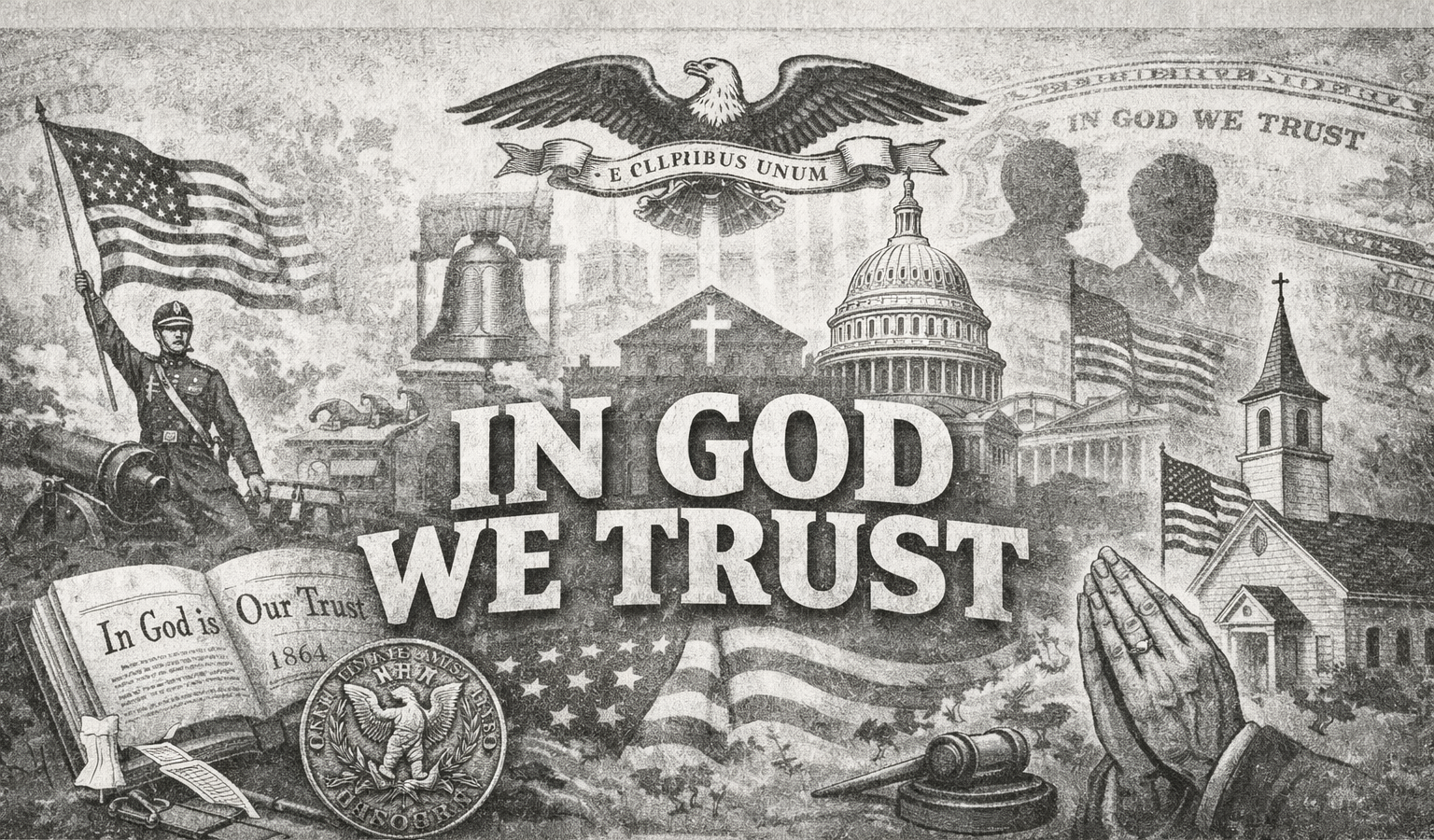
War—even a war of liberation or defense—lowers the level of humanity, and, sadly, often precisely in the victim. By this logic, in Chechnya the struggle for freedom began with Dudayev, a European and an atheist, and slid down to Kadyrov and his son. By this logic, Islam became the ideology of those fighting U.S. military hegemony. But two centuries earlier, by the same logic, English colonists descended several steps compared to England. Washington and Jefferson were essentially Enlightenment atheists in the guise of “deists.” Yet in their texts they found it necessary to mention God and Providence.
At that point, a divergence occurred: Canada, Australia, New Zealand, and England became entirely “secular” countries—that is, populated mainly by agnostics in the guise of “Anglicans.” The United States, meanwhile, became the only Western country in which religiosity—or, more precisely, piety—has steadily increased. The escalation of religiosity coincides with an escalation of violence and self-importance. From general references to Providence, it moved to an 1814 song that declared:
“Praise the Power that has made and preserved us as a nation. We must prevail, for our cause is just—and this be our motto: ‘In God we trust.’”
“In God we trust” is, in the plural, a phrase from Psalm 55:12, “Elohim batach” in Hebrew. In 1748, in Pennsylvania, Franklin created a militia unit that adopted these words as its motto. In the Psalms, trust in God is mentioned often, but always in the first person, never as “we.” The phrase became popular precisely in a song composed during the British fleet’s bombardment of Baltimore in 1811. The music was taken from a British composer with the very common name John Smith (the same melody later became the basis of the Russian romance “Khasbulat the Brave”).
The anthem began to be performed in the White House during World War I and was declared the national anthem of the United States in 1931 (before that, the U.S. had no official anthem). The words “In God we trust” appeared on coins during the Civil War in 1864. In 1892, when the discovery of America was being celebrated, Baptist pastor and Christian socialist Francis Bellamy inserted them into the “Pledge of Allegiance” for youth. Bellamy was an enthusiast of “Americanization”: he distrusted Catholic immigrants (Irish, Italians) and believed it necessary to re-educate their children in loyalty to God rather than to the Pope.
The Pledge was turned into a state act by Roosevelt—again during wartime—on June 22, 1942. In 1956, the U.S. Congress made “In God we trust” the national motto. The motto appears on the Great Seal and on dollar bills. Before that, the motto had been “E pluribus unum” (“Out of many, one”). The initiative for the change came from the Knights of Columbus, a conservative Roman Catholic organization that convinced President (and General) Eisenhower that the new motto was more appropriate during the Cold War with the “red threat.”
American atheists and some believers have tried through the courts to remove references to God from the Pledge and from banknotes. Jehovah’s Witnesses consider oaths sinful. But when, in 1962, advocates of freedom of conscience succeeded in court in banning mandatory prayer in schools, the U.S. Congress ordered the words “In God we trust” to be inscribed on the Speaker’s rostrum. In 2011, the mandatory status of the motto was reaffirmed by a special vote of Congress. Polls show that an absolute majority of Americans support the existence of the motto.
It is more complicated among educated Americans: Democrats are mostly against the motto, while the right, Republicans, are in favor. The motto is considered part of a “civil religion”—that is, the manipulation of religious language to sustain the idea of the “nation.” In other words, a religious truth is taken and made part of a non-religious falsehood and a form of coercion.
The American emergency physician Michael Newdow has, since 2004, actively sought through the courts to abolish the motto as contradicting the principle of the separation of church and state. Courts consistently reject the lawsuits, explaining that it is a “historical tradition” and part of the “national consciousness.” This explanation is itself quite false: first, a nation has no consciousness; second, if something exists in consciousness, it does not impose itself on others. Moreover, in English, “consciousness” also means “conscience.”
The Apostle Paul writes that Christians “rely on Him” (2 Corinthians 1:10). The Qur’an (Surah Yunus 10:85 and others) contains similar words: “In Allah we trust” (“Allahi tawakkalna”).
In 2023, in Israel, the Shas party called for placing this motto on banknotes, but the bill was not approved.
Translated from the original Russian article “In God We Trust”: the manipulation of religion in the name of the nation by Yakov Krotov.