
 DE
DE  RU
RU  UK
UK 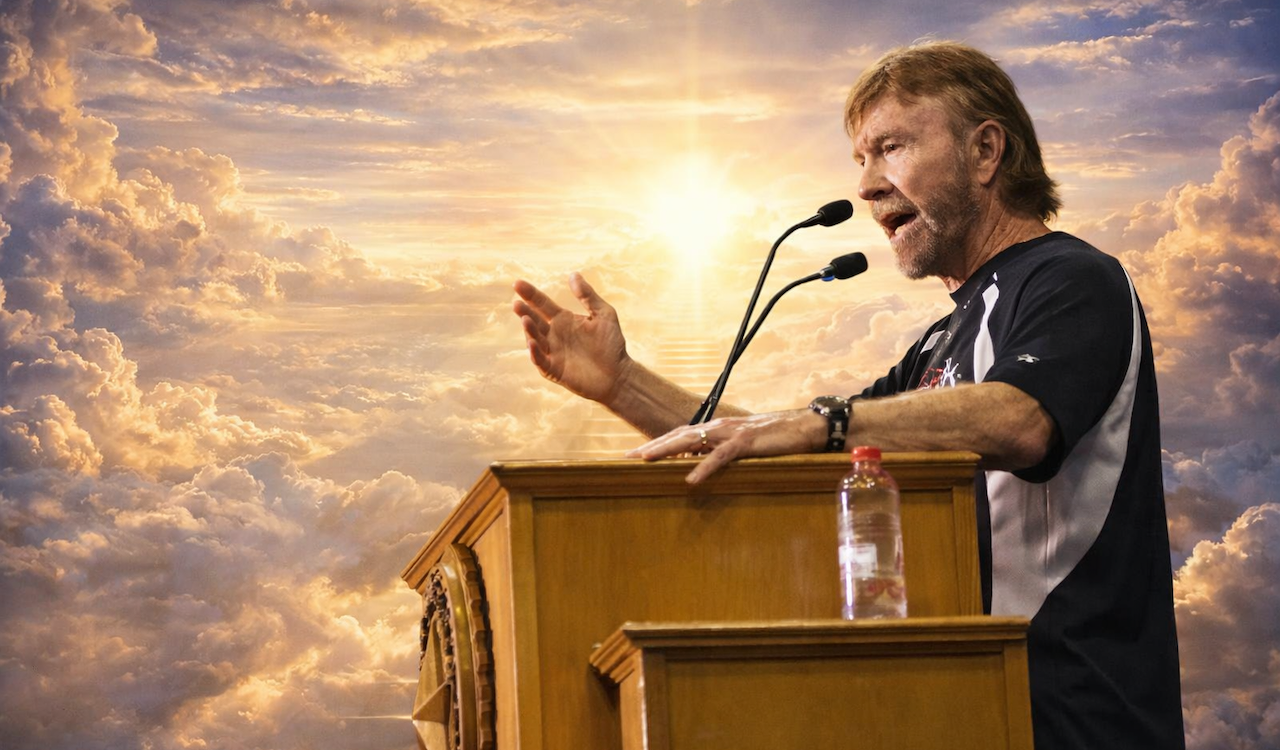
➕ Table of Contents
The death of Chuck Norris makes one pause and look deeper than his cinematic image allows. For millions, he remained a symbol of strength, resilience, and even a certain humorous myth — a man who always wins. But behind this image stood another story — less loud, yet far more important.
This is a story of the search for meaning, inner struggle, and faith that has nothing in common with Hollywood invincibility. At a certain point in his life, Norris faced what every person faces: the limits of his own strength. And it is precisely where physical power ends that space for something greater begins.
His journey is not just the biography of an action star. It is a testimony of how a person who could rely only on himself discovers dependence on God. And perhaps that is why his story sounds different today: as a reminder that true strength is measured not by blows, but by faith.
Who Was Chuck Norris: More Than an Action Hero
Chuck Norris was born into an ordinary family and did not look like someone destined to become a global symbol of strength. His path began far from Hollywood — with military service, where he first seriously became interested in martial arts. It was there that the discipline was formed that would later define his entire life.
After returning to civilian life, Norris did not simply continue training — he began to win. His karate career quickly placed him among the best fighters of his time. He not only earned titles but also developed his own style, combining technical precision with inner focus.
Hollywood opened another arena for him. First as a martial artist, and later as an actor, Norris became the embodiment of a hero who always controls the situation. His roles — from action films to the series Walker, Texas Ranger — created the image of a man who knows no defeat. This image became so deeply rooted in mass culture that it eventually turned into a separate phenomenon — the ironic “Chuck Norris facts,” where his strength is taken to absurd extremes.
However, this entire story is only the outer layer. Behind it stood a real person who, despite fame and success, sought answers to much deeper questions. And it was this search that would later determine the main turning point in his life.
I always found strength not in myself, but in God.
Spiritual Turning Point: How He Came to Faith
Behind the outward confidence and discipline of Chuck Norris there was a tension that did not disappear even with success. His career was growing, recognition was coming, but inner questions remained unresolved. This became especially evident during periods of personal difficulty — in family life, in the sense of a gap between the image of a “strong man” and the reality of a person who does not control everything.
An important role in his spiritual turning point was played by his environment, particularly his wife, who led him to reflect on faith not as an abstraction, but as a living experience. It was not an instant change — rather a process in which skepticism gradually gave way to openness. Norris began reading the Bible, asking questions, and seeking answers not in achievements, but in truth.
True victory is not defeating another, but defeating yourself.
The key realization was a simple yet radical truth: one’s own strength has limits. And it is precisely where it ends that the possibility of trusting God opens up. For a person accustomed to relying only on himself, this meant not weakness, but a new kind of strength — one that does not depend on physical or psychological resources.
This turning point did not destroy his personality but redefined it. Strength remained, but its source changed. From that moment on, his life began to be built not around control, but around faith.
Faith as the Center of Life
After his spiritual turning point, faith for Chuck Norris ceased to be merely a private matter or an episode in his biography. It became the reference point through which he began to rethink all areas of his life — from family to career.
Norris did not hide his convictions. On the contrary, he increasingly spoke about faith publicly — in speeches, interviews, and books. For him, Christianity was not reduced to moral principles or tradition. It was a relationship with God that transforms the way one thinks and acts. He emphasized that true strength lies not in controlling others, but in the ability to trust and to live according to truth.
To be strong does not mean to be invincible. It means to remain faithful.
This shift was especially noticeable in his attitude toward family. What previously could have taken a back seat to career became a priority. Faith formed a new hierarchy: God, family, service — and only then professional achievements.
At the same time, his understanding of strength took on a different meaning. If before strength meant victory, now it meant faithfulness. Not the ability to win a fight, but the ability to remain faithful even when it is difficult. In this sense, his life became a kind of testimony: outward power may impress, but it is inner strength that defines who a person truly is.
Service and Mission
I believe that God gives us strength not so that we may dominate, but so that we may serve.
For Chuck Norris, faith did not remain at the level of beliefs — it gradually turned into action. His life after the spiritual turning point increasingly took on the features of service, especially in his work with youth.
One of the most notable directions was the Kickstart Kids initiative — a program that combines martial arts with character development. For Norris, this was not just sport or discipline. It was about forming an inner core: responsibility, self-control, respect, and the ability to make moral choices. In this approach, it is easy to see a reflection of his own journey — from strength as a tool to strength as service.
His activities also included participation in Christian initiatives, support for family values, and public testimony of faith. Importantly, he did not try to impose his beliefs — rather, he offered an example. In a culture where strength is often associated with domination, Norris showed a different model: strength that helps lift others up.
This aspect of his life often remained in the shadow of his media image. Yet it is precisely here that the depth of his transformation is revealed. If earlier he was known as someone who defeats opponents, later he became known as someone who helps others not to lose their own lives.
The Paradox of Strength: Between the Image of a Hero and Christian Humility
The image of Chuck Norris in mass culture was built on absolute strength. A hero who never loses, never doubts, and never retreats — this is how millions remember him. But this image sharply contrasts with what the Christian tradition offers.
In Christianity, strength is not a self-sufficient value. It gains meaning only when it is subordinated to truth and love. Moreover, true strength often manifests not in domination, but in the ability to deny oneself — in humility, forgiveness, and service. For a person who was associated all his life with physical superiority, accepting such an understanding meant a profound inner transformation.
Norris himself repeatedly emphasized that his faith changed his view of strength. It ceased to be a means of control and became a responsibility. It is no longer about defeating another, but about not losing oneself. Not about external invincibility, but about inner faithfulness.
The more I achieve, the more I realize how dependent I am on God.
This is the paradox of his life. A man whom the world knew as a symbol of absolute strength ultimately acknowledged its limits. And it was precisely this recognition that opened for him another, deeper reality — one in which strength does not oppose humility, but is born from it.
Death and Hope: A Christian Perspective
The death of Chuck Norris inevitably brings one back to a question that goes beyond any biography: what comes next? For a culture accustomed to seeing him as “invincible,” the very reality of death appears paradoxical. But it is precisely here that the Christian perspective shifts the focus.
Christianity does not deny death — it gives it a different meaning. It ceases to be a final defeat and becomes a transition. Not the negation of life, but its completion in the temporal dimension and its opening into eternity. That is why for a believer, death is not only a reason for sorrow, but also a reminder of hope.
In this light, Norris’s life can be read as a journey that does not end with physical death. If his strength was truly reinterpreted through faith, then his story is not limited to achievements or roles. It continues in a dimension where neither victories nor defeats matter in the usual sense.
For the reader, this is also a challenge. The death of a famous person always draws attention, but rarely changes anything in our own lives. The Christian perspective offers something else: not just to remember, but to reflect. If even the “strongest” faces the limit, then the question is not how to avoid it, but with what to meet it.
Chuck Norris — Not Only a Symbol of Strength, but an Example of Faith
The life of Chuck Norris can easily be reduced to a set of achievements: champion, actor, cultural phenomenon. But such an approach misses the main point. His story is not about strength as the ability to win, but about strength as the ability to change.
He began as a person who relied on discipline and his own efforts. He went through a path where this confidence revealed its limits. And he came to understand that true support lies beyond himself. This shift — from self-sufficiency to faith — is the key to understanding his life.
His example shows that outward success does not answer the most important questions. Strength that impresses the world does not always respond to inner challenges. And at the same time, even someone who seems unshakable can discover another, deeper foundation.
Ultimately, Norris’s story poses a simple but uncomfortable question: what is your strength built on? And will it withstand the moment when external resources stop working?
Short Reference Biography
Chuck Norris (Carlos Ray Norris Jr.)
- Date of birth: March 10, 1940
- Place of birth: Ryan, Oklahoma, USA
🥋 Martial Arts and Competitions
- Began practicing karate during his service in South Korea
- Multiple-time U.S. karate champion (1960s–1970s)
- Founder of the Chun Kuk Do style
- Trained celebrities, including Steve McQueen
- Won the professional karate world championship in 1968
🎬 Film and Television Career
- Film debut: The Wrecking Crew (1969)
- Breakthrough role alongside Bruce Lee in Way of the Dragon (1972)
- Notable films:
- Good Guys Wear Black (1978)
- Missing in Action (1984)
- The Delta Force (1986)
- Most famous TV project: Walker, Texas Ranger (1993–2001)
🙏 Faith and Denomination
- Publicly professed Christianity (Protestantism, Evangelical tradition)
- Actively supported Christian initiatives
- Founder of the Kickstart Kids program, combining martial arts with moral and spiritual education for youth
🧩 Other Facts
- Author of books, including works on faith, morality, and life principles
- Military service: United States Air Force
- One of the most recognizable cultural phenomena of the internet (“Chuck Norris facts”)