
 DE
DE  RU
RU  UK
UK 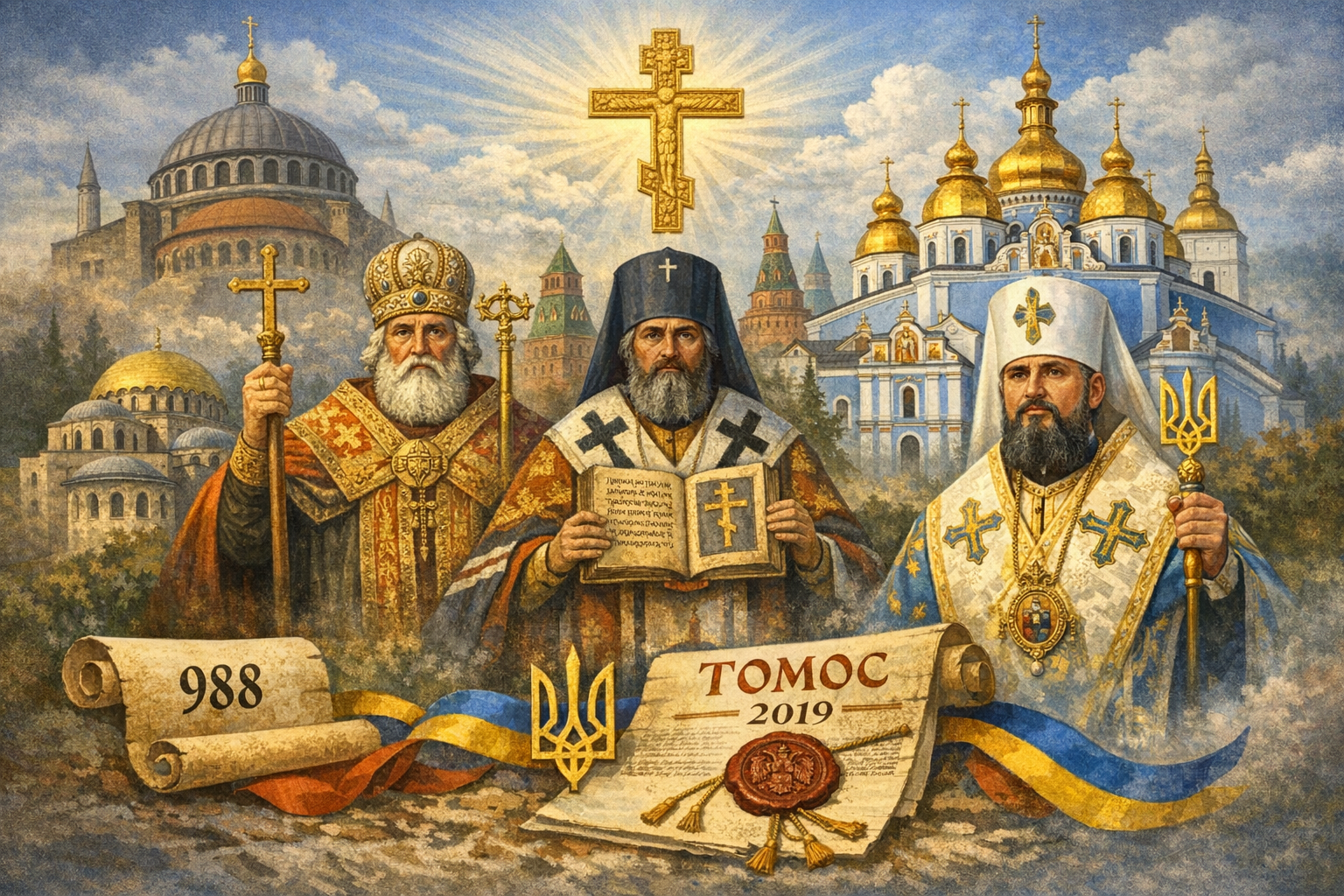
➕ Table of Contents
The history of the Orthodox Church of Ukraine is often presented in simplified or mutually exclusive narratives. For some, it begins in 2018 as a new ecclesial structure; for others, it is a continuation of the Kyiv Patriarchate or the Ukrainian Autocephalous Orthodox Church. At the same time, within a church-historical perspective there exists another, no less substantiated vision: the Orthodox Church of Ukraine as the ancient Kyiv Metropolis restored in its rights, founded in 988 and canonically connected to the Patriarchate of Constantinople.
Each of these approaches has its own arguments and historical grounds. However, in Orthodox ecclesiology decisive importance belongs not only to the historical narrative, but also to the canonical perspective. It is precisely this perspective that determines how the Church is perceived within universal Orthodox communion, what place it occupies among other Local Churches, and how its future is shaped.
This article proposes a view of the history of the Ukrainian Church from the position of the Patriarchate of Constantinople—the Mother Church of the Kyiv Metropolis. Such an approach makes it possible to view events not as the history of the “creation of a new Church,” but as a long and complex process of loss, division, and gradual restoration of the canonical fullness of the Kyiv ecclesial tradition. It is within this logic that contemporary autocephaly appears not as a political or situational act, but as the final stage of a centuries-long historical and canonical development.
The Foundation of the Kyiv Metropolis of the Patriarchate of Constantinople (988)
The Baptism of Rus’ at the end of the tenth century was not only a spiritual, but also an ecclesiastical-institutional event. In 988, a metropolis was founded in Kyiv which from the very beginning was part of the Patriarchate of Constantinople. It was the Ecumenical Throne that appointed the Kyiv metropolitans, defined the boundaries of their jurisdiction, and incorporated the Kyiv see into the overall system of church governance of the Eastern Church.
From the outset, the Kyiv Metropolis held a special significance. It was a missionary center for the vast expanse of Eastern Europe and at the same time was directly subordinated to Constantinople, bypassing any intermediate ecclesial authorities. Such a status underscored its importance and made Kyiv one of the key centers of Orthodoxy beyond the borders of the Byzantine Empire proper.
For several centuries, Kyiv remained the canonical center of the Church of Rus’, even despite political cataclysms, changes in state borders, and the gradual weakening of princely Kyiv. The canonical unity of the metropolis with Constantinople was not interrupted, and the metropolis itself understood itself as part of a broader universal ecclesial community.
This initial fact—the foundation of the Kyiv Metropolis as part of the Patriarchate of Constantinople—is key to understanding the entire subsequent history of the Ukrainian Church. All later divisions, changes of status, or administrative transformations occurred in relation to this primary canonical reality, not in place of it.
The Separation of the Moscow Metropolis and the Division of the Kyiv Metropolis (15th Century)
Beginning in the thirteenth century, political and cultural processes of the former Kyivan Rus’ gradually shifted to the northeast. The Mongol invasion, the decline of Kyiv, and the growing influence of the Vladimir-Suzdal and later Moscow principalities led to the Kyiv metropolitans increasingly residing outside Kyiv. At the same time, the Kyiv Metropolis as a canonical structure did not cease to exist and remained within the jurisdiction of the Patriarchate of Constantinople.
In the fourteenth and early fifteenth centuries, this process unfolded within the framework of a single Kyiv Metropolis. Metropolitans who in practice governed from Vladimir or Moscow continued to bear the title “of Kyiv and All Rus’” and received consecration from the Patriarch of Constantinople. However, the gradual rise of Moscow’s political self-consciousness created tension between canonical unity and the de facto ecclesial-state autonomy of the northeastern lands.
A turning point came with the events related to the Council of Florence in 1439. Metropolitan Isidore of Kyiv, who supported the union between the Eastern and Western Churches, upon returning to the northeastern lands was arrested in Moscow and removed from governance. His support of the decision of the Ecumenical Council became, for the Moscow authorities, grounds for breaking with Constantinople, which at that time was in eucharistic communion with Rome.
In 1448, already after the Council of Florence, Metropolitan Jonah was unilaterally installed in Moscow without the blessing of the Patriarch of Constantinople. This act signified the de facto separation of the northeastern part of the Kyiv Metropolis and initiated the existence of a separate ecclesial structure operating independently of the Ecumenical Throne.
That same year, the former Constantinopolitan patriarch-uniate Gregory III Mammas appointed Isidore’s disciple, Gregory the Bulgarian, as metropolitan for the western Rus’ lands with his see in Kyiv. This appointment was confirmed by Pope Pius II in a bull dated September 3, 1458, by which the former Kyiv Metropolis was formally divided into two parts, with both metropolitans bearing the title of Kyiv. Gregory the Bulgarian and his successors received the title of Metropolitans of Kyiv, Halych, and All Rus’ and exercised their ministry in the lands under Lithuanian and Polish rule, while Metropolitan Jonah, with almost the same title, ruled in Moscow.
The northeastern part of the former Kyiv Metropolis, centered in Moscow, after the death of Metropolitan Jonah in 1461, began to elect its own primates. Metropolitan Theodosius and his successors adopted the title of Metropolitans of Moscow and were confirmed by a council of Russian hierarchs. At the same time, the Moscow metropolitans retained only formal subordination to the Patriarchate of Constantinople. The Patriarchs of Constantinople, although they did not bless the installation of the Moscow metropolitans, did not openly protest against this order, recognizing it as a de facto state of affairs. Thus, in the second half of the fifteenth century, a situation of dual ecclesial reality emerged, in which two metropolises existed that both appealed to the heritage of the ancient Kyiv see. This division, закрепленное papal bull and the political circumstances of the era, did not mean the cessation of the Kyiv Metropolis as such. Rather, it marked the beginning of a prolonged period of parallel existence of ecclesial centers, the consequences of which defined the history of Ukrainian and Moscow Orthodoxy over the following centuries.
The Union of Brest of 1596 and the Crisis of the Kyiv Metropolis
The division of the Kyiv Metropolis, formalized by the papal bull of 1458, created a prolonged situation of ecclesial instability in the Ukrainian-Belarusian lands. The Orthodox metropolis, which maintained a canonical connection with Constantinople, existed under conditions of political and legal pressure from a Catholic state. During the second half of the fifteenth and sixteenth centuries, its position gradually weakened, creating favorable conditions for new attempts to subordinate it to the Roman See.
At the end of the sixteenth century, part of the episcopate of the Kyiv Metropolis, seeking protection of its estate rights and support from the state authorities of the Polish–Lithuanian Commonwealth, entered into negotiations with Rome. The result of these agreements was the Union of Brest of 1596, under which several Orthodox bishops, led by the metropolitan, recognized the supremacy of the Pope of Rome while preserving the Eastern rite.
The Union of Brest led to a deep ecclesial schism. Formally, the Uniate hierarchy assumed the administrative structures of the Kyiv Metropolis, while the Orthodox community was in fact left without a fully functioning canonical hierarchy. A significant portion of the clergy, brotherhoods, and laity refused to accept the union, but their ecclesial life found itself in a state of canonical uncertainty.
The crisis caused by the Union of Brest was not only theological or canonical. It had profound social and cultural consequences, shaping a conflict between the Orthodox tradition of Kyiv and the Uniate project supported by the state and the Roman See. Under these conditions, the question of restoring the Orthodox hierarchy became not only an ecclesial necessity, but also a matter of preserving ecclesial and national identity.
It was precisely this crisis that directly led to the events of the early seventeenth century, when an attempt was made to restore the canonical fullness of the Kyiv Metropolis by reestablishing the hierarchy within the jurisdiction of Constantinople.
The Restoration of the Orthodox Hierarchy of the Kyiv Metropolis (1620)
After the Union of Brest, the Orthodox Kyiv Metropolis found itself in a state of deep canonical crisis. Formally, the metropolitan structure was occupied by the Uniate hierarchy, while Orthodox faithful, clergy, and brotherhoods were left without lawfully ordained bishops. In the absence of a hierarchy, normal ecclesial life—ordinations, courts, governance—became impossible, threatening the complete decline of the Orthodox tradition in these lands.
Under these circumstances, Orthodox brotherhoods and the Cossacks played a key role by taking the initiative in restoring the ecclesial structure. In 1620, taking advantage of the presence of Patriarch Theophanes III of Jerusalem in the Polish–Lithuanian Commonwealth, a secret but canonically justified restoration of the Orthodox hierarchy was carried out. Patriarch Theophanes, acting with the blessing of the Patriarchate of Constantinople, ordained the Metropolitan of Kyiv and several bishops for the principal sees.
This act restored the canonical continuity of the Kyiv Metropolis, which had been interrupted as a result of the Union of Brest. Despite resistance from state authorities and the Uniate hierarchy, the Orthodox Church once again obtained a full ecclesial structure capable of carrying out pastoral ministry and defending the interests of the faithful.
The restoration of the hierarchy in 1620 became a turning point in the history of the Kyiv Metropolis. It testified not only to the vitality of the Orthodox tradition, but also to the decisive role of the Ecumenical Patriarchate in preserving canonical order. From that moment, the Kyiv Metropolis once again functioned as a full ecclesial structure canonically connected to the Throne of Constantinople.
At the same time, this step did not eliminate the division caused by the union. On the same territories, Orthodox and Uniate hierarchies continued to coexist, leading to tensions and conflicts throughout the seventeenth century. It is within this context that subsequent events related to changing political realities and the status of the Kyiv Metropolis should be understood.
The Temporary Transfer of the Kyiv Metropolis under the Administration of the Moscow Patriarchate (1686)
In the second half of the seventeenth century, political circumstances in the Ukrainian lands changed significantly. As a result of the Pereiaslav Agreement of 1654 and subsequent changes in authority over Left-Bank Ukraine, the Kyiv Metropolis found itself within the sphere of influence of the Moscow Tsardom. Under these conditions, Moscow began to seek control over the Kyiv see, which formally remained under the jurisdiction of Constantinople.
In 1686, by agreement between Moscow and Constantinople, an act of administrative subordination of the metropolis to the Moscow Patriarchate took place. It is important to note that this act was a temporary administrative measure, not a transfer of full canonical jurisdiction. According to the documents of the time, Constantinople retained the right to ultimate governance of the Kyiv Metropolis, but allowed the Moscow Patriarch to exercise administrative functions in practice.
This temporary transfer entailed limitations on the autonomy of the Metropolitan of Kyiv: his installation, confirmation, and part of his administrative authority were coordinated with the Moscow Patriarch. At the same time, Constantinople did not formally lose its rights over the metropolis and retained canonical jurisdiction.
The consequence of this decision was the de facto strengthening of the role of the Moscow Patriarchate in ecclesial governance in Left-Bank Ukraine, while at the same time the Kyiv Metropolis remained, in a historical and canonical context, part of the Church of Constantinople. This period laid the groundwork for further discussions about the autonomy and self-governance of the metropolis, which continued over the following centuries.
The Kyiv Metropolis as an Exarchate within the Russian Orthodox Church
After the administrative subordination to the Moscow Patriarchate in 1686, the Kyiv Metropolis effectively existed as a structure within the Russian Orthodox Church. Although Constantinople formally retained canonical jurisdiction, in practice governance of the metropolis was carried out by the Moscow Patriarchate. The Metropolitans of Kyiv were appointed with the participation of the Moscow Patriarch, and important administrative and judicial decisions were coordinated with Moscow ecclesial authorities. This situation became entrenched for several centuries, complicating the canonical autonomy of the Kyiv Metropolis and weakening its connection with the Ecumenical Patriarchate.
In 1722, an archbishop was appointed in place of a metropolitan, which signified a further restriction of the independence of the Kyiv see. In 1921, the structure received the status of an exarchate. At the same time, the metropolis remained a spiritual center for Ukrainian Orthodoxy and preserved its own traditions and rites.
This period demonstrated that, although governance in practice passed to Moscow, the historical and canonical continuity of the Kyiv Metropolis remained intact.
In effect, the Kyiv Metropolis was simultaneously part of the Russian Church and, canonically, a component of the Patriarchate of Constantinople, which never recognized the annexation of the metropolis by Moscow. This canonical argumentation would later become key to the restoration of the autocephaly of the Ukrainian Church in the twenty-first century.
The Status of the Self-Governing Ukrainian Orthodox Church within the ROC
At the end of the twentieth century, the Kyiv Metropolis received the status of a self-governing Church and its own name: the Ukrainian Orthodox Church (UOC) within the Moscow Patriarchate. The structure received its own primate—the Metropolitan of Kyiv—who governed the internal life of the Church, appointed bishops, and exercised administrative functions in the territories under its control.
However, this autonomy was limited. Important decisions, including the confirmation of the metropolitan, the maintenance of church discipline, and administrative matters, were coordinated with the Moscow Patriarch. Such a status ensured a degree of internal independence for the UOC, but did not change its actual canonical subordination to Moscow.
The status of a self-governing Church became a compromise solution between the need for autocephaly and the actual control of the Moscow Patriarchate, which was unwilling to satisfy this need despite an official appeal from the episcopate of the UOC.
This long period of subordination and limited autonomy created the preconditions for the future restoration of the canonical connection of the Kyiv Metropolis with Constantinople and for preparation for the process of autocephaly, which began in the early twenty-first century.
The Council of the Kyiv Metropolis with the Participation of Hierarchs of the UOC-KP and UAOC (2018)
The restoration of the canonical jurisdiction of the Throne of Constantinople over the UOC in 2018 resolved a key task—the overcoming of the longstanding ecclesial division in Ukraine. The existence of parallel Orthodox jurisdictions outside eucharistic communion with universal Orthodoxy was not only a canonical anomaly, but also a pastoral problem for millions of faithful.
On December 15, 2018, a Unification Council took place in Kyiv which, in the ecclesial-canonical sense, was the Council of the UOC as the returned Kyiv Metropolis of Constantinople. It was attended by hierarchs, clergy, and laity from various ecclesial branches, including representatives of the Ukrainian Orthodox Church–Kyiv Patriarchate and the Ukrainian Autocephalous Orthodox Church (both churches dissolved themselves prior to the Council), as well as bishops who were in canonical subordination to the Moscow Patriarchate.
It is fundamental that the Council was not an act of “merging jurisdictions” or creating a new Church from scratch. It took place within the canonical reality of the Kyiv Metropolis, restored in its rights by the Ecumenical Throne. It was in this context that hierarchies ordained during the period of schism were recognized through the lifting of canonical prohibitions and their reception into communion without re-ordinations.
This approach corresponded to the established canonical practice of the Orthodox Church, which in similar situations prioritized the healing of divisions and the restoration of unity rather than a formal revision of all historical circumstances of episcopal ordinations. In this sense, the Council of 2018 had above all a reconciliatory and restorative character.
The culmination of the Council’s work was the election of a new primate—the Metropolitan of Kyiv—who led the Kyiv Metropolis in the process of acquiring autocephalous status. This election testified to the completion of the internal stage of ecclesial unification and the readiness of the metropolis for the next step—the official proclamation of autocephaly.
The Unification Council of 2018 became not a starting point, but a point of healing. It summarized centuries of divisions and became the immediate transition to the act of granting autocephaly, which definitively secured the canonical status of the Orthodox Church of Ukraine within universal Orthodox communion.
The Granting of Autocephaly to the Orthodox Church of Ukraine (2019)
The final stage of the centuries-long historical and canonical process was the granting of autocephaly to the Kyiv Metropolis, restored in its rights in 2018. On January 6, 2019, in Constantinople, the Ecumenical Patriarch solemnly handed the Tomos of autocephaly to the primate of the Orthodox Church of Ukraine.
The Tomos established the Kyiv Metropolis as a subject of autocephaly, that is, as a full-fledged Local Church within universal Orthodoxy. It was not about creating a new ecclesial reality, but about granting independent status to the same Kyiv see which since 988 had been in canonical connection with the Patriarchate of Constantinople and since 1686 had been temporarily limited in its rights due to historical circumstances.
According to the text of the Tomos, the autocephaly of the Orthodox Church of Ukraine is based on the canonical continuity of the Kyiv Metropolis, not on jurisdictions that arose as a result of later divisions. This emphasized the continuity of the Kyiv ecclesial tradition and its right to independent ecclesial life within its own historical boundaries.
The granting of autocephaly also determined the place of the Orthodox Church of Ukraine in the system of inter-Orthodox relations. The OCU entered the diptychs of autocephalous Churches as a full participant in universal communion, while preserving its canonical connection with the Mother Church. Such a model corresponds to the established practice of the Ecumenical Throne regarding new autocephalies and does not contradict Orthodox ecclesiology.
At the same time, autocephaly does not mean the automatic disappearance of all Ukrainian ecclesial problems or immediate pan-Orthodox recognition. It rather became a canonical foundation for the further process of integrating the remaining dioceses of the ROC in Ukraine into universal Orthodoxy, which—it should be emphasized—does not depend on the reception of this decision by other Local Churches.
Thus, the Tomos of 2019 recorded the result of a long journey—from the foundation of the Kyiv Metropolis within the Patriarchate of Constantinople to its solemn elevation to the status of an autocephalous Church. In this perspective, autocephaly appears not as an exceptional or political act, but as a canonically natural conclusion of the historical development of the Kyiv ecclesial tradition.
Conclusion: A History of Restoration and Development
The history of the Orthodox Church of Ukraine, viewed from a church-canonical perspective, appears not as a chain of random or politically conditioned decisions, but as a long process of loss, division, and gradual restoration of the Kyiv ecclesial tradition. Beginning with the foundation of the Kyiv Metropolis in 988 as part of the Ecumenical Patriarchate, its canonical identity was formed in close connection with Constantinople and was not destroyed even during periods of the deepest historical crises.
The divisions of the fifteenth to seventeenth centuries, the Union of Brest, the loss of hierarchy, the temporary administrative subordination to the Moscow Patriarchate—all these events did not eliminate the Kyiv Metropolis as a historical reality. They only limited or deformed its functioning under specific political conditions. That is why the restoration of the rights of the Kyiv Metropolis in the twenty-first century did not require the “creation of a new Church,” but rather a return to the original canonical order.
The key role in this process was played by the Patriarchate of Constantinople as the Mother Church of the Kyiv Metropolis. It was precisely the Ecumenical Throne that preserved the canonical memory of Kyiv’s original status, not equating historical deviations with the norm. In this sense, the decisions of 2018–2019 were not an overreach of authority, but the exercise of Constantinople’s responsibility for its own ecclesial heritage.
The autocephaly of the Orthodox Church of Ukraine logically fits into the general ecclesiological tradition of Orthodoxy, in which the independence of a Local Church is a form of maturity rather than a rupture with universal unity. It does not abolish historical ties, but transforms them into a new model of interaction—based on equality, mutual recognition, and responsibility.
From this perspective, the contemporary Orthodox Church of Ukraine is the heir of the Kyiv Metropolis not only historically, but also canonically. Its autocephaly appears as the completion of a centuries-long process of acquiring ecclesial fullness, not as the result of political circumstances. Further pan-Orthodox recognition of the OCU is a matter of time, but at the same time—a test of the maturity of the Local Churches: they are not endowed with the authority to legitimize the decisions of Constantinople, since it does not require external legitimation; yet, according to ancient ecclesial tradition, they have the opportunity to bear witness to their own fidelity to pan-Orthodox unity, forever inscribed in the shared Symbol of Faith.