
 DE
DE  RU
RU  UK
UK 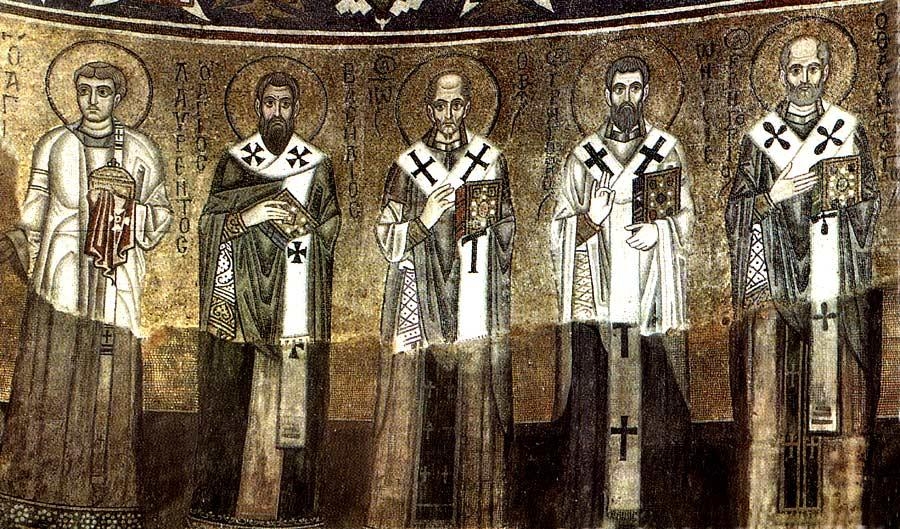
One of the main questions dividing Orthodox and Catholics today is the issue of the primacy of the Pope of Rome — the primacy of the Apostle Peter and his successors in the Church. We present to our readers a list of quotations from the writings of the Fathers of the Church of the first millennium, in which the primacy of the Apostle Peter and his See — the Church of Rome — is considered.
The Holy Fathers on the Primacy of the Apostle Peter
St. Ephrem the Syrian
“Rejoice, Peter, mouth of the disciples, voice of the preachers, eye of the apostles, guardian of heaven, firstborn among those who received the keys into power.” (Ephrem the Syrian, “Encomium to Peter, Paul, Andrew, Thomas, Luke and John, and on the reading from the Gospel of John”).
St. Basil the Great
“Peter was one of such mountains; and the Lord gave the promise to build His Church upon this rock.” (Works of St. Basil the Great, “Commentary on Isaiah,” ch. 2; II, 93–94; p. 66, Mg. 30, 233).
St. John Chrysostom
“Why did the Son of God shed His blood? In order to acquire those sheep which He entrusted to Peter and his successors.” (“Works,” St. Petersburg, D. A., I, 415).
St. Cyprian of Carthage
“There is one God, and one Christ, and one Church, and one chair founded by the word of the Lord upon the rock.” (Works of St. Cyprian of Carthage, I, 124).
St. Gregory of Nyssa
“And the great Peter, clinging to the rock, became Peter.” (Works of St. Gregory of Nyssa, III, 375). “...with the change of name, he is transformed by the Lord into something more divine, and instead of Simon he is named and made Peter.” (“Works of St. Gregory of Nyssa,” Moscow, 1862; Homily 15, III, 374).
St. Epiphanius of Cyprus
“He to whom the flock is entrusted is an excellent guide by the power of the Lord God.” (Ancoratus 9; Mg 43, 33).
St. Leo the Great
“And still, from the whole world one Peter is chosen who is set over (praeponitur) both the work of converting all and over all the apostles and over all the Fathers, so that Peter — although in the people of God there are many priests and many pastors — may govern those whom Christ governs more excellently.” (St. Leo the Great, Ml 54, 149–150).
St. Theodore the Studite
“Peter loved more than all, as he himself testified… for this (threefold) testimony he received as a reward the right to pasture all… Peter, because he loved more, held the primacy…” (“Works of St. Theodore the Studite,” St. Petersburg, 1908, vol. II, p. 143).
Nikephoros of Constantinople, Patriarch — Letter to Leo III, Pope of Rome
“O strong one in the Lord, pray for us, most holy and most blessed brother, having as mediator and helper before God our common intercessor and protector, the great and chief Apostle, to whom do not disdain to offer prayers for us, his unworthy servants.”
Bl. Theophylact, “Commentary on the Gospel of Matthew”
“Here also note that marriage does not at all hinder virtue: for even the chief apostle had a mother-in-law.”
The Holy Fathers on the Primacy of the Roman Church
Bl. Jerome
“Primacy belongs to the Roman Church because she is the chair of Peter, the ark of salvation, and the fortress that supports all. Peter is the special one chosen among the twelve, so that by establishing the head he might safeguard the Church from schisms.” (Against Jovinian I, 26).
“… I resolved to seek instruction from the Chair of Peter… although your greatness causes me to tremble… Following Christ first of all, I unite myself with your blessedness, that is, with the Chair of Peter. I know that upon this rock the Church is built; whoever eats the lamb outside this house is a stranger to the sacred assembly; whoever is not in the ark of Noah will perish in the flood… Whoever does not gather with you scatters, i.e., whoever is not Christ’s is antichrist’s.” (“Works,” Kyiv D. A., I, 44–47).
Venerable Theodore the Studite
“If anything doubtful arises,” then command “to receive clarification from Ancient Rome, as was done of old and from the beginning according to the tradition of the Fathers. For there… is the highest of the Churches of God, on whose throne the first sat — Peter, to whom the Lord said: ‘Thou art Peter…’.” (“Works,” St. Petersburg D. A., 1908. II, 447.)
St. Maximus the Confessor
“How much more is this so with the clergy and the Church of the Romans, which from ancient times to this day has held primacy over all the churches under the sun? She undeniably received this lawfully, both from the Councils and the Apostles and from the princes thereafter; and being ranked among them, she is not subject to the writings or commands of conciliar documents, since by the height of her pontificate even in all such matters all are nonetheless subject to her according to the sacred law. Thus, when without fear but with holy and fitting trust these ministers (the popes) come from the truly firm and unshakable Rock, that is, from the greatest and Apostolic Church of Rome…” (Maximus, in J. B. Mansi, ed., Amplissima Collectio Conciliorum, vol. 10).
“If the Roman See recognizes Pyrrhus not only as impious but as a heretic, it is definite and clear that those who anathematize those who reject Pyrrhus also anathematize the Roman See — that is, anathematize the Catholic Church. I hardly need to add that he also excommunicates himself, if indeed he is in communion with the Roman See and the Catholic Church of God. Let him hasten before all else to satisfy the Roman See, for if it is satisfied, all will unanimously call such a one pious and orthodox. For he wastes his words who thinks he must persuade or entrap people like me, instead of satisfying and imploring the blessed Pope of the Most Holy Catholic Roman Church — that is, the Apostolic See — which from the Incarnate Son of God Himself, and from all the holy councils, according to the holy canons and decrees, received universal and supreme dominion, authority, and power to bind and loose over all the Churches of God throughout the world.” (Maximus, Letter to Peter, in Mansi X, 692).
“All the boundaries of the universe and everywhere on earth, whoever confesses the Lord purely and orthodoxly, unceasingly look to the Most Holy Church of the Romans as at the sun of eternal light, receiving from her the shining radiance of the paternal and holy dogmas… For from the very beginning, from the descent of God the Word in the flesh among us, all Christian Churches everywhere received and hold that greatest among them — the Roman Church — as the only fortress and foundation, as eternally unconquerable by the promise of the Savior against the gates of hell, having the keys of the orthodox faith in Him.” (Migne PL, 110, 137–140).
“He has lost holiness who voluntarily departed from the Catholic Church. It is not permitted under any guise to praise him who, for his inclination to heresy, was condemned by the Roman Apostolic See and excommunicated by it until he returns again to that See and is received by it.” One must “satisfy the rules” and address “one’s pleas to the Most Holy Pope of the Holy Roman Church, that is, to the Apostolic See, which received from the Incarnate God the Word and from all the Councils, according to the holy canons, full authority over all the holy Churches of God in all the world, as well as the power to bind and loose.” (Mg. 91, 144).
St. Theodore the Studite of Constantinople (From a Letter to Emperor Michael)
“Let him (Patriarch Nikephoros of Constantinople) gather a council of those with whom he differs in opinions, and if it is impossible for representatives of other Patriarchs to be present, it could certainly be, if the Emperor so willed, that the Patriarch of the West (the Pope of Rome) should be present, to whom authority has been given over the ecumenical council; but let them bring about peace and unity by sending conciliar letters to the prelate of the First See.” (Theodore the Studite, Patr. Graec. 99, 1420).
“We held a general council, at which dignitaries sat and presided, a council violating the Gospel of Christ, whose keys you received from Him through the chief of the apostles and his successors down to the predecessor of your sacred head.” “Of this we, the lowliest children of the Catholic Church, deemed it necessary to inform You, our foremost apostolic head. However, to devise and do what is pleasing to God belongs to you, guided by the Holy Spirit, as in other matters, so also in this…” (“Works,” St. Petersburg D. A., 1908. II, 267–270, Letter to Pope Leo III).
St. Basil the Great
“And for us it seemed timely to write to the Roman Bishop, so that he might attend to the matters here and be moved to authorize himself in this matter — due to the difficulty of sending anyone from there by common and conciliar decision — by choosing people who would be able… to bring back to understanding those who have gone astray among us.” (“Works,” MDA translation, St. Petersburg, 1911, III, 94, §65(69)).
St. Peter Chrysologus
“…we advise you, most honorable brother, to listen with humility to everything written by the most blessed Bishop of the city of Rome; for St. Peter, who lives and presides on his throne, reveals the truth of faith to those who seek it. For we, out of love for peace and the faith, cannot investigate matters of faith apart from the agreement of the Bishop of Rome.” (Acts of the Ecumenical Councils, vol. 2, St. Petersburg, p. 30).
Letter of Tarasius, Most Holy Patriarch of Constantinople, New Rome, to Adrian, Pope of Old Rome
“The divine Apostle Peter, whose throne your brotherly sanctity has inherited, rejected such men, like Simon the Magician. Therefore we do not hesitate to proclaim the truth, preserving and holding what was handed down to us in the rules of the holy apostles and our glorious Fathers; and if any have broken these things, we turn away from them. Your brotherly sacred episcopate, rightly and according to the will of God fulfilling its hierarchical duty, has acquired great renown.”
Nikephoros of Constantinople, Patriarch — “Apologetic Word to the Universal Church concerning the new discord regarding the holy icons”
“Thus trampling the troubled Church, the impious Constantine, arming himself even more stubbornly against our orthodox dogmas, without the hierarch of the imperial city (for Anastasius, who held the See after the venerable Germanus, had already died at that time) and without inviting the hierarch of Old Rome or any other See, according to the Church canon, following his impious desire — or rather, taking advantage of a tyrant’s insolence — despising the divine laws, through the shameless bishops he had gathered, did everything in his power to arrange their (icons’) overthrow, daring — the godless man — to call Christians idolaters and decreeing in the decision of that ungodly assembly that henceforth no one should venerate or make holy icons.”