
 DE
DE  RU
RU  UK
UK 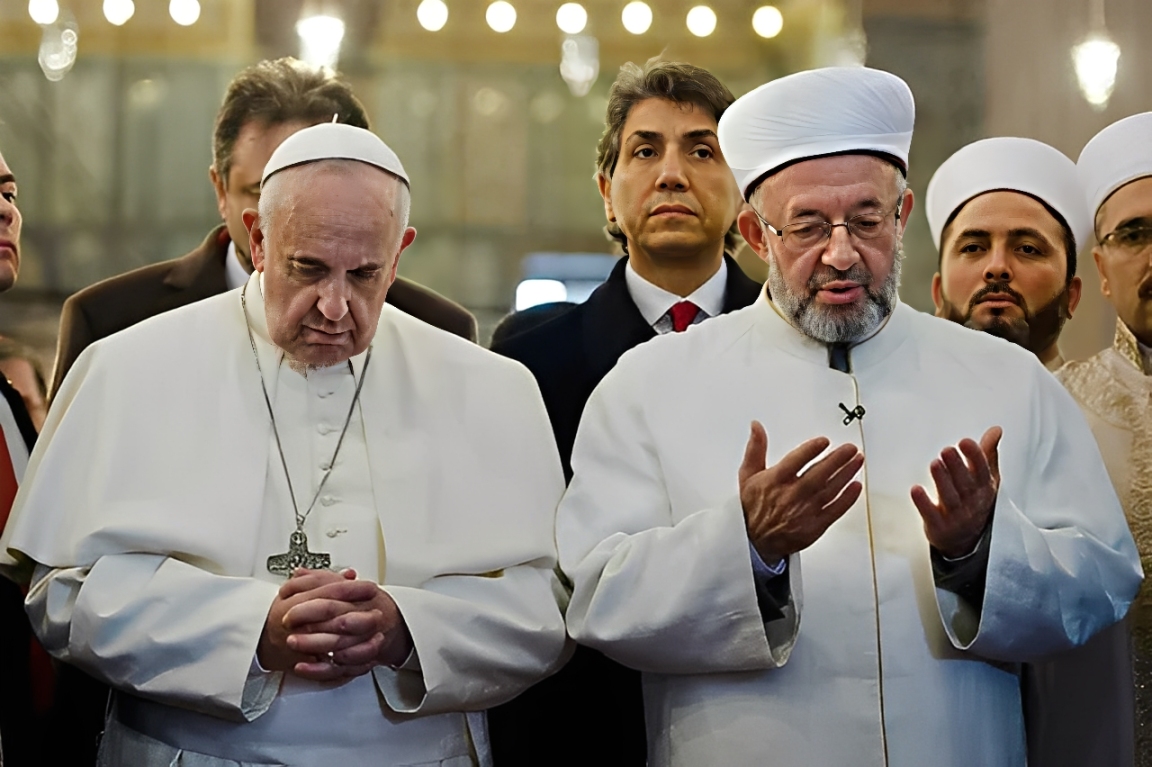
➕ Table of Contents
The Second Vatican Council’s declaration Nostra Aetate (1965) marked a significant development in the Catholic Church’s approach to non-Christian religions. Among these, Islam receives a concise yet remarkably meaningful treatment. Though brief—only one paragraph—the statement on Muslims profoundly shaped subsequent Catholic thought, dialogue, and pastoral practice. The document neither constructs a full theological system nor erases doctrinal differences; instead, it situates Islam within God’s wider salvific plan while promoting respect, dialogue, and mutual understanding.
Recognition of a Shared Monotheistic Faith
Nostra Aetate emphasizes first and foremost that Catholics and Muslims worship the one God. The Council explicitly states that Muslims “adore the one God, living and subsisting in Himself; merciful and all-powerful, the Creator of heaven and earth.” This affirmation reflects a theological continuity: both traditions confess the God of Abraham, even though their doctrines differ regarding His nature and revelation.
This acknowledgement was groundbreaking. Historically, Western Christian theology frequently labeled Islam as a heresy or a distortion of Christian truth. Nostra Aetate does not revisit this polemical history but instead centers on what is shared: monotheism, divine sovereignty, and God’s mercy. By doing so, the Council reframed Catholic-Muslim relations on a foundation of common faith in God rather than conflict.
Reverence for Jesus and Mary in Islam
A notable aspect of Nostra Aetate is its mention of Muslims’ esteem for Jesus as a prophet and their particular reverence for Mary, whom the document calls “His virgin Mother.” The Church does not claim that Muslims affirm Christ’s divinity or salvific mission, but it recognizes an existing honor that can serve as a basis for dialogue.
This recognition functions on two levels:
- Doctrinal. It acknowledges shared figures but does not minimize the crucial Christian doctrines of the Trinity and Incarnation, which Islam rejects.
- Pastoral. It points to bridges of understanding that can enhance cooperation and spiritual respect.
Ethical Common Ground
Nostra Aetate also remarks on the moral and religious seriousness of Muslims: their commitment to prayer, almsgiving, and fasting. These practices parallel fundamental Catholic spiritual disciplines. By highlighting these similarities, the Church acknowledges Islam as a tradition fostering genuine piety and virtue.
This ethical emphasis reveals the Council’s broader purpose: to promote a world where religious people, despite doctrinal differences, contribute to justice, peace, and moral integrity.
Historical Reconciliation and the Call to “Forget the Past”
One of the most striking sentences in the declaration urges Catholics and Muslims to “forget the past” and strive for “sincerity and mutual understanding.” Though the Church does not erase the long and often painful history between Christianity and Islam, it calls believers to move beyond conflict, prejudice, and mistrust.
This appeal is rooted in the Church’s self-understanding after the horrors of the twentieth century: Christians are called to be ministers of reconciliation (2 Cor. 5:18). Thus, Nostra Aetate links doctrine with a moral imperative to promote peace.
Respect Without Doctrinal Relativism
Although the tone of Nostra Aetate is positive, it does not imply theological equivalence between Christianity and Islam. The Council refrains from doctrinal synthesis and remains faithful to Christian dogma concerning Christ’s divine sonship, the Trinity, and the Church’s unique role in salvation history.
Later magisterial documents—including Lumen Gentium, Redemptoris Missio, and the teachings of Popes John Paul II and Benedict XVI—clarify that:
- The Church sees “rays of truth” in Islam.
- Muslims can know and love God.
- Yet the fullness of revelation is found only in Christ.
Thus, Nostra Aetate establishes a framework for respect and dialogue without diluting the distinctiveness of Christian faith.
Implications for Contemporary Catholic-Muslim Relations
In the decades following Vatican II, Nostra Aetate became the foundation for institutional dialogue:
- The Vatican established the Pontifical Council for Interreligious Dialogue.
- Numerous popes engaged in personal meeting and gestures of mutual respect with Muslim leaders.
- Catholic scholars and theologians developed more nuanced understandings of Islamic theology.
These developments flow directly from the principles articulated in Nostra Aetate: recognition of common belief in God, affirmation of moral and spiritual values, and the call to cooperation.
Catholic Church and Islam
Nostra Aetate remains one of the most influential documents in shaping the Catholic Church’s contemporary view of Islam. It does not present Islam as an alternative path to salvation equal to Christianity, nor does it downplay doctrinal differences. Instead, it invites Catholics to recognize Muslims as fellow believers in the one God, to appreciate the genuine piety present in Islamic life, and to engage Muslims with respect, friendship, and a commitment to peace.
In an age marked by religious conflict and misunderstanding, the Council’s measured yet hopeful approach continues to offer a model for how Christians and Muslims might live together as neighbors under the gaze of the same merciful Creator.